

GET YOUR FREE PDF REPORT!
The Definitive
Kansas City
Home Buying Guide
A comprehensive, market-specific reference for every type of buyer — from first-timers navigating their first offer to investors underwriting their fifth rental. Written by the team at Reco Real Estate Advisors with one goal: give you real knowledge, not generic checklists.

What's Inside
Use the sections below to jump to what matters most. First-timers: read cover to cover. Investors: start with Section 3 and Chapter D. Relocators: begin with Section 2 and the county profiles.
Built on Market Intelligence. Driven by Results.
At Reco Real Estate Advisors, we don't believe in generic real estate advice. We believe in knowing the Kansas City market deeper than anyone else in it — the neighborhoods, the economics, the schools, the investment fundamentals — and putting that knowledge to work for every client we represent.
Whether you're purchasing your first home in Olathe, acquiring a hospitality asset across the metro, or building a residential portfolio in Jackson County, our team brings the same analytical discipline and market depth to every transaction.
Kansas City is one of the most undervalued real estate markets in the country. We consider it our job to make sure our clients capture that advantage — every time.
Achievements & Recognitions
KW Overland Park · KC Metro

What We Do
Full-service real estate advisory across every asset class and transaction type in the Kansas City metro.
The Reco Team
Five specialists. One integrated team. Every discipline covered in-house.




Talk to our team — no obligation, just a real conversation about your goals.
Welcome & How to Use This Guide
At Reco Real Estate Advisors, we believe the best transactions happen when buyers arrive educated. Not just about the process — about the market. Too many buyers walk into one of the most consequential financial decisions of their lives with information scraped from Zillow and a half-remembered conversation with a coworker who bought a house three years ago. We built this guide to change that.
This is not a checklist. It's not a legal disclaimer dressed up as advice. It's what we'd tell you if you sat across from us in our office on day one — the real picture of the Kansas City metro, the transaction process as it actually works here, and the honest pros and cons of every major market you might be considering. We've written it to serve multiple types of buyers simultaneously, because the KC metro attracts all of them.
How to Navigate This Guide
- First-time buyers: Read it cover to cover. The process section (Section 4) and your buyer-type chapter (Chapter A in Section 5) are foundational. Don't skip the glossary in Section 7 — know the terms before you need them.
- Upsizers and downsizers: You know the process; what you need is the market. Dive into Section 3 for the county-by-county data, then your buyer chapter in Section 5.
- Rental property investors: Start with the Big Picture in Section 2 (Kansas vs. Missouri dynamics matter), then go straight to Section 3's investor data fields for each area, and Chapter D in Section 5.
- Relocation buyers: Begin with Section 2 — the KC geography orientation — then read the county overviews in Section 3 to shortlist where you want to land. Chapter E in Section 5 is written for you.
- Luxury buyers: The Johnson County deep-dive in Section 3 and Chapter F in Section 5 are your primary resources.
The Dual-State Reality
The Kansas City metro straddles two states — and that's not just geography, it's finance, law, and lifestyle. Kansas and Missouri operate under different property tax structures, different income tax regimes, different landlord-tenant laws, different school funding models, and different MLS conventions.
When you ask "where should I buy in KC?" the answer isn't just a neighborhood — it's a state. We'll give you the full picture throughout this guide so you can make that call with open eyes.
About Reco Real Estate Advisors
Reco Real Estate Advisors is a KW Partners affiliate serving the Kansas City metro. We operate at the intersection of commercial intelligence and residential service — meaning our team brings investment analysis, market data fluency, and negotiation discipline to every transaction, whether it's a first home or a five-property portfolio.
Reco serves buyers across the full Kansas City metro — both Kansas and Missouri sides — with deep expertise in Johnson County KS luxury residential, KC metro commercial, investment properties, multifamily assets, and Midwest hospitality real estate. Every client benefits from the same institutional analytical lens regardless of transaction size.
Understanding the KC Metro — Big Picture
Before you look at a single listing, you need to understand what kind of market you're entering. Kansas City is not one market — it's seven counties, two states, dozens of school districts, and hundreds of zip codes, all behaving differently at any given moment.
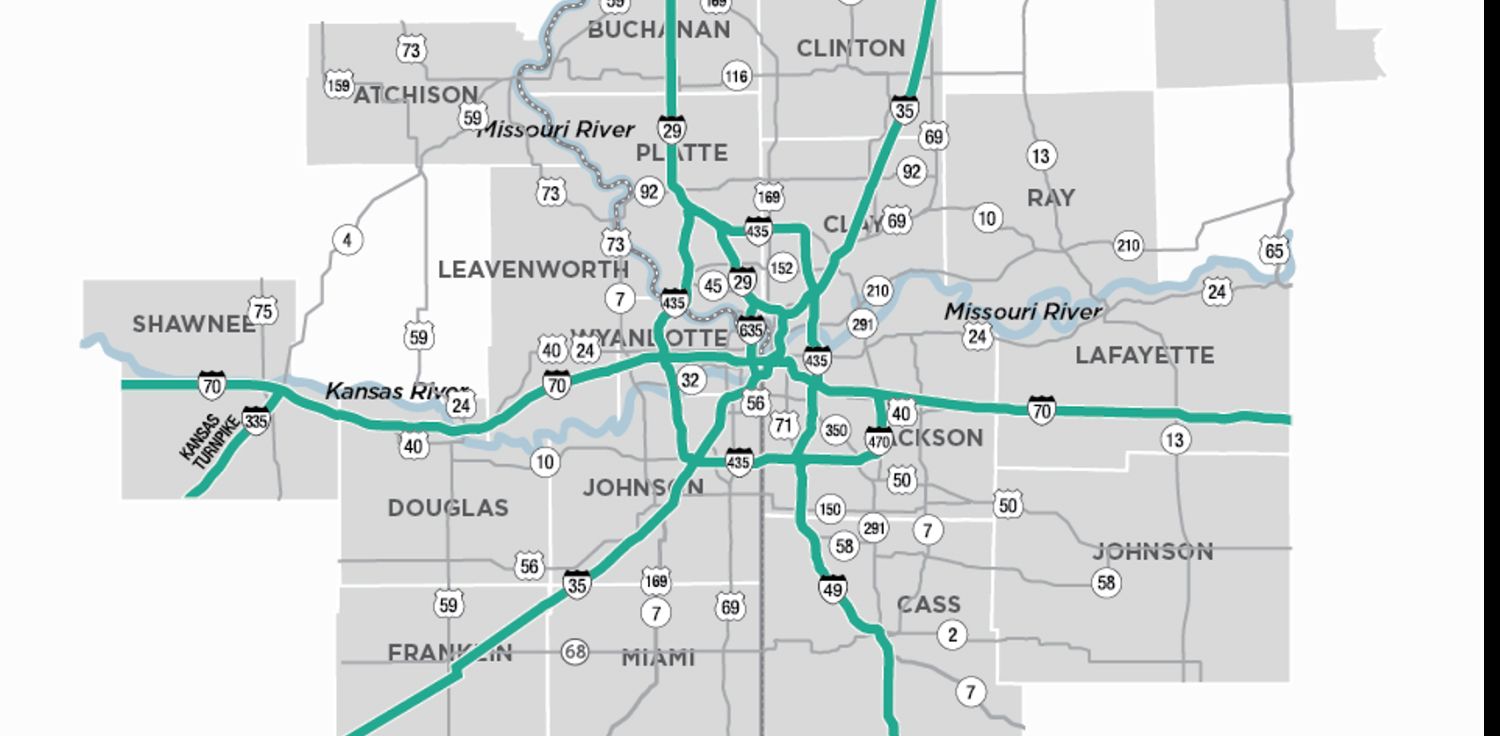
The KC Metro Geography
The Kansas City metro spans approximately 7,000 square miles across Missouri and Kansas with a combined population nearing 2.2 million. The Missouri River bisects the metro east-to-west; the state line runs north-to-south through the center of the urban core.
Four interstates define how the metro moves and where people live relative to where they work:
- I-35 — the north-south spine of the Kansas side, connecting Olathe, Overland Park, and Lenexa southward to Gardner and beyond, and north toward downtown KC and eventually the Northland.
- I-70 — the primary east-west corridor. It splits downtown KC, carries traffic through Independence and Blue Springs on the Missouri side, and crosses into KCK on the Kansas side.
- I-435 — the circumferential beltway looping around the southern and eastern metro. It's the commuter ring that makes south Johnson County and south KC metro accessible without touching downtown.
- I-470 — the southern Missouri bypass, connecting Lee's Summit, Raytown, and the Independence corridor. Critical for Cass County buyers commuting north.
Understanding these routes isn't just trivia. Where you live relative to your employer along these corridors is the single biggest quality-of-life variable for most KC buyers.
Kansas vs. Missouri Side
This distinction shapes everything from your monthly payment to your estate plan.
Property Taxes: Johnson County KS typically runs 1.2%–1.5% effective rate on assessed value. Jackson County MO runs 1.0%–1.4%, though assessment practices vary widely. Wyandotte County KS can be higher relative to home values. Always run the actual annual tax estimate on any home you're considering — it can swing your monthly payment by $300–$500+.
Income Taxes: Kansas has a flat-ish income tax structure with rates topping around 5.7%. Missouri tops out near 4.95%. For high-income earners, this difference is real money annually. Consult your CPA — some buyers specifically choose one side of the state line for tax optimization.
School Funding: Kansas funds schools heavily through property taxes, which is why Blue Valley USD and Shawnee Mission USD in Johnson County are so well-resourced — the tax base supports it. Missouri districts are more variable, with state funding formulas that create wider gaps between districts.
HOA Culture: Far more prevalent on the Kansas side, particularly in Johnson County. You will almost certainly buy into an HOA if you're purchasing a new-construction or post-1990 home in Overland Park, Olathe, or Lenexa. Missouri side HOAs exist but are less universal.
Landlord Law: Missouri is more landlord-friendly than Kansas, with shorter statutory eviction timelines — a real consideration for investors choosing a state to build a portfolio.
Current Market Conditions
The KC metro has experienced sustained appreciation since 2019, with inventory remaining tight across most submarkets. Buyers should confirm current MLS data with their agent — the figures below are directional benchmarks reflecting 2024–2025 trends. Always ask your agent for live days-on-market and months-of-supply data before making a pricing decision.
2026 Price Performance by Submarket
Source: KCRAR, Redfin, NAR · Q1 2026 · Confirm current data with your agent.
| Submarket | Median Price | YoY Change | Avg. DOM |
|---|---|---|---|
| Leawood, KS | $650,000+ | +3.8% | 28 |
| Overland Park, KS | $485,000 | +4.1% | 34 |
| Prairie Village, KS | $410,000 | +4.0% | 32 |
| Olathe, KS | $375,000 | +5.2% | 38 |
| Lenexa / Shawnee, KS | $360,000 | +4.8% | 40 |
| Lee's Summit, MO | $320,000 | +5.0% | 42 |
| Blue Springs, MO | $270,000 | +4.5% | 46 |
| N. Kansas City, MO | $210,000 | +7.1% | 51 |
Why Relocators Choose Kansas City
KC consistently ranks among the top 10 most affordable major metros in the country — but "affordable" undersells it. You're not trading down in lifestyle; you're getting more of it for less money.
- Cost of living: Housing costs run roughly 30–40% below the national average for comparable home sizes. A $450,000 home in Johnson County would be $800,000–$1.2M in Denver, Austin, or Nashville for equivalent quality and schools.
- Job market: Anchored by healthcare (HCA Midwest, KU Health System, Children's Mercy), tech (Cerner/Oracle Health, Garmin, T-Mobile HQ in Overland Park), financial services (UMB, Commerce Bank, Nuveen/TIAA), and logistics (KC sits at the geographic center of the US — FedEx, UPS, and freight networks love it).
- Airport access: KCI (Kansas City International) completed a brand-new single terminal in 2023. Nonstop routes to 60+ destinations. For business travelers, it's a genuine competitive advantage over markets where the airport is 45 minutes away and miserable.
- Sports culture: The Chiefs (back-to-back-to-back Super Bowl contenders), the Royals (storied franchise), and the KC Current (NWSL powerhouse with a purpose-built stadium) give KC a sports identity that punches above its population weight.
- Food & arts: KC barbecue is world-class and not a cliché. The restaurant scene — from the 18th & Vine jazz corridor to the Crossroads Arts District to Westport — is legitimate. The Nelson-Atkins Museum of Art and the Kauffman Center for the Performing Arts are nationally recognized institutions.
KC Seasonal Market Patterns
The KC real estate market is highly seasonal. Knowing the calendar gives you a strategic edge.
Market Intelligence by County and Area
This is the intelligence you'll come back to repeatedly. Every county and area profile follows the same format so you can compare apples to apples. Data is directional — confirm current figures with your Reco agent before making any pricing or investment decision.
Johnson County, Kansas
The flagship county of the KC metro — highest median incomes, top-ranked schools, dominant luxury market, and the economic engine of the Kansas side.
Johnson County is the wealthiest county in Kansas and one of the wealthiest in the Midwest. It's anchored by two powerhouse school districts — Blue Valley USD 229 and Shawnee Mission USD 512 — that consistently rank among the top in the state and draw families from across the metro and from out of state. The county's corporate base along the I-435/Metcalf corridor (T-Mobile HQ, Garmin, Black & Veatch, Cerner/Oracle Health) means short commutes for thousands of white-collar professionals who also want elite schools and well-maintained neighborhoods.
HOAs are the norm here. Covenant restrictions keep neighborhoods cohesive but also limit what you can do with your property. Buyers from other parts of the country often find Johnson County's HOA culture more intense than they expected — read the CC&Rs before you close, not after.
The county's growth corridor has been pushing south and southwest — Gardner and Spring Hill are the current frontier of affordability within JoCo. The northern tier (Prairie Village, Mission, Merriam) offers older, often more characterful housing stock at prices that look attractive relative to Overland Park's new-construction product.
Overland Park
Overland Park is the second-largest city in Kansas and the commercial heart of Johnson County. It's not one neighborhood — it's a sprawling city that spans dramatically different product types and price points depending on where you are within it. Treat it as three distinct sub-markets: North OP, Central OP, and South OP.
North Overland Park (roughly north of 95th St)
Character: Older, more established neighborhoods with mature trees and stronger community identity. Proximity to Prairie Village and the Country Club Plaza gives North OP a character distinct from the new-construction suburban feel of the south. Ranch homes, split-levels, and mid-century two-stories from the 1960s–1980s are the dominant stock.
Housing Stock: 1,200–2,200 sq ft ranches and two-stories, built primarily 1965–1995. Expect deferred maintenance items on older mechanicals — sewer scopes and radon tests are essential here. Some infill patio homes and newer townhomes near major retail corridors.
Price Range: Starter: $250K–$325K. Mid: $325K–$475K. Renovation plays can start in the $220s.
Days on Market: Fast — typically 10–21 days for well-priced homes. Well below metro average.
Appreciation: Moderate-to-strong. The proximity to Prairie Village and the character of the older housing stock has driven consistent demand.
School Information
North OP straddles the Shawnee Mission USD 512 boundary. Elementary schools within SM include Shawnee Mission East and Shawnee Mission North feeder schools — ask your agent for the exact attendance boundary for any home you're considering, as these have shifted. Niche rates many SMSD elementaries highly. Private options: Cure of Ars School, Pembroke Hill (nearby), Notre Dame de Sion.
Lifestyle & Amenities
Excellent restaurant access via 119th Street and Metcalf Avenue corridors. Nearby Corbin Park and Town Center Plaza for retail. Johnson County Park system provides trails and parks throughout. Commute to downtown KC: 20–30 minutes via I-35 or Metcalf. KU Med corridor: 15–25 minutes.
✓ Pros
- Mature trees, established neighborhood character
- More affordable entry points than south OP
- SMSD school system access
- Strong appreciation history on renovated homes
- Good commute access via I-35 and Metcalf
- Less HOA intensity than south OP subdivisions
✗ Cons
- Aging infrastructure — sewer laterals often need attention
- Radon levels elevated — test every home
- Less new construction; renovation required to modernize
- Some areas feel dated relative to price point
- Traffic on Metcalf can be brutal during peak hours
Buyer-Type Fit
| Buyer Type | Fit | Notes |
|---|---|---|
| First-Timer | Strong | Good inventory under $300K; lower property taxes vs. Missouri side for same quality |
| Upsizer | Moderate | Move-up inventory exists but competition is fierce; better upsize value in central OP |
| Downsizer | Moderate | Some patio home options; not as many condo/townhome choices as south OP |
| Investor | Strong | BRRRR plays on older ranches; renovation adds meaningful value; rental demand solid |
| Luxury | Low | Price ceiling here; luxury buyers should look central/south OP or Leawood |
| Relocator | Strong | Accessible price point for KC newcomers; SMSD schools a major draw |
💼 Investor Data — North Overland Park
STR Viability: Limited — Overland Park has STR registration requirements and most HOAs restrict short-term rentals. Long-term rental is the play. BRRRR Opportunity: Strong on distressed 1960s–1980s ranches that can be renovated and refinanced. Watch sewer lateral replacement costs ($5K–$15K) in your renovation budget. City Registration: Overland Park requires rental property registration and periodic inspections.
Central Overland Park (95th St to 135th St)
Character: The corporate core of JoCo. Home to T-Mobile's campus, major retail at Corporate Woods and Corbin Park, and a mix of planned subdivisions from the 1980s–2000s. This area is exceptionally convenient but can feel more suburban-corporate than the north or south ends of OP.
Housing Stock: 1,500–2,800 sq ft two-stories and ranches, 1985–2005 construction. Many subdivisions with active HOAs. Some newer townhome communities near retail corridors.
Price Range: Mid: $350K–$500K. Move-up: $500K–$700K. Entry: $280K–$350K.
Days on Market: Fast — 12–24 days for well-priced product.
Schools: Primarily Blue Valley USD 229 in the southern half, Shawnee Mission in the northern half. Ask for the exact feeder school for any address. Blue Valley schools are nationally ranked — this is a major driver of demand in this price tier.
Lifestyle: Extremely car-dependent. Best-in-class suburban retail and dining. Commute to downtown KC 25–35 minutes. T-Mobile campus and Cerner/Oracle Health within 10–15 minutes of most addresses.
✓ Pros
- Blue Valley USD access — top-ranked schools
- Short commute to JoCo corporate corridor
- Excellent retail and dining within 5 minutes
- Well-maintained planned neighborhoods
- Strong long-term appreciation
✗ Cons
- Heavily car-dependent; minimal walkability
- HOA restrictions can be strict and costly
- Suburban sameness — neighborhoods feel similar
- Traffic on Metcalf/119th/135th intersections
💼 Investor Data — Central Overland Park
Blue Valley schools drive strong rental demand from families who can't yet afford to buy in the district. Cap rates compressed vs. north OP due to higher purchase prices. Long-term appreciation story is stronger than cash flow story here. HOA fees typically $50–$150/month — factor into your analysis.
South Overland Park (south of 135th St)
Character: The newest growth frontier of the KC suburban landscape. South OP — including areas like Wolf Run, Lionsgate, Nottingham Forest, and new communities extending toward 179th Street — is where you find the most recent construction, the biggest lots in the outer rings, and the highest concentration of luxury new-build product in the metro.
Housing Stock: Predominantly post-2005 construction. New-build communities from builders like Rodrock Homes, James Engle Custom Homes, and Starr Homes. Lot sizes range from 1/4 acre in denser subdivisions to 1+ acre estate lots near 167th–179th Street.
Price Range: Entry new construction: $475K–$600K. Mid-tier move-up: $600K–$900K. Luxury estates: $900K–$2M+.
Days on Market: Moderate — 20–35 days. Higher price points mean longer marketing windows.
Schools: Almost entirely Blue Valley USD 229. Blue Valley North, Blue Valley Southwest, and Blue Valley West high schools serve this area. BV is routinely ranked among Kansas's top 5 districts statewide.
Lifestyle: This is the lifestyle many KC families are aspirationally working toward. Beautiful, planned communities with pools, walking trails, and community amenities. Car-dependent by design. New retail follows growth here — the 159th Street corridor has become a secondary commercial spine. Commute to downtown KC is 35–45 minutes — the tradeoff for this lifestyle is distance.
✓ Pros
- Best new construction product in the metro at this price point
- Blue Valley USD — one of Kansas's best districts
- Larger lots and newer mechanicals vs. north OP
- Community amenities (pools, trails, ponds) built in
- Strong resale market driven by continued growth
- Low crime rates; high community investment
✗ Cons
- Longest commute in Johnson County to downtown KC
- New construction quality varies by builder — vet thoroughly
- HOA fees can be $150–$400/month in amenity-heavy communities
- Limited character — many neighborhoods look similar
- Some flood risk in lower elevation areas near creeks
| Buyer Type | Fit | Notes |
|---|---|---|
| First-Timer | Low | Price points start too high for most first-timers |
| Upsizer | Strong | The primary destination for JoCo move-up buyers with children |
| Downsizer | Moderate | Maintenance-free patio home communities exist; lot of stairs in 2-story product |
| Investor | Low | Cap rates very compressed; not a cash flow play |
| Luxury | Strong | Best luxury new construction in the KC metro |
| Relocator | Strong | Families relocating for school district quality come here |
💼 Investor Data — South Overland Park
Cap rates are the lowest in the metro here. This is an appreciation play, not a cash flow play. Corporate relocation executives seeking temporary housing drive the luxury rental demand. STR largely prohibited by HOA covenants. Unless you're banking on significant appreciation, other submarkets offer better investment returns.
Leawood
Character: Leawood is the most prestigious residential address in the KC metro — a well-planned, mature community with exceptional infrastructure, high household incomes, and a deep bench of luxury housing stock. The Ranch Club, Iron Horse, Hallbrook Farms, and Mission Hills Drive neighborhoods are where KC's medical, legal, and business elite live. Leawood is not flashy about its affluence — it's understated, private, and self-sustaining.
Housing Stock: The breadth here is wider than most buyers expect. The eastern edge near State Line Road offers 1970s–1990s ranch and two-story product in the $450K–$650K range. The western and southern tiers — Iron Horse, Ranch Club, Hallbrook — are $800K–$4M+ estates on large, heavily landscaped lots.
Price Range: Entry: $400K–$600K. Mid luxury: $700K–$1.2M. Upper luxury: $1.2M–$4M+.
Days on Market: Moderate — luxury product typically 30–60 days. Entry-level Leawood moves faster.
Appreciation: Strong and consistent. Leawood has proven resilient through market cycles due to the depth and quality of its buyer pool.
School Information
Shawnee Mission USD 512 serves most of Leawood, with Leawood Elementary and Leawood Middle School having strong reputations. Shawnee Mission East High School feeds from here and is among the most academically regarded public high schools on the Kansas side. Private options within 10 minutes: Pembroke Hill, Notre Dame de Sion, Saint Thomas Aquinas (Olathe).
Lifestyle & Amenities
Town Center Crossing and Leawood Town Center deliver the metro's highest concentration of luxury retail, dining, and services — Nordstrom, Macy's, The Capital Grille, and dozens of independents. Hallbrook Country Club and Leawood South Country Club provide private golf access. The KC Art Institute and Nelson-Atkins are 20 minutes north. Commute to downtown KC: 25–35 minutes. KU Health System: 20–25 minutes.
✓ Pros
- Prestige address with strong resale value floor
- Best luxury housing stock in the metro
- Excellent schools (SMSD) and private school proximity
- Best retail and dining corridor in JoCo
- Quiet, private, masterplanned luxury neighborhoods
- Low crime; high community investment
✗ Cons
- Entry price is high — limited product below $400K
- HOA fees in luxury communities run $300–$800+/month
- Very car-dependent; minimal walkability
- Less diversity than other KC submarkets
- Dated interiors common in 1990s luxury stock
| Buyer Type | Fit | Notes |
|---|---|---|
| First-Timer | Low | Not the market — price points start high |
| Upsizer | Strong | The aspirational move-up destination for JoCo buyers |
| Downsizer | Strong | Excellent maintenance-free condo and patio home options near Town Center |
| Investor | Low | Cap rates barely pencil; not an investor's market |
| Luxury | Strong | Top luxury market in KC metro — deep, quality inventory |
| Relocator | Strong | The "safe choice" for corporate relos who want the best address without research risk |
💼 Investor Data — Leawood
Leawood is an appreciation play, full stop. Cap rates are among the lowest in the metro. The investment thesis is capital preservation and long-term appreciation in a high-barrier-to-entry submarket. Corporate relocation temporary housing is the primary rental play at the luxury tier. HOAs and high property taxes make the math difficult for traditional rental investors.
Prairie Village
Character: Prairie Village is the most walkable, most neighborhood-centric community in Johnson County — and increasingly, in the entire metro. Built primarily in the 1950s and 1960s as KC's first wave of suburban development, PV has the bones of a traditional town: the Prairie Village Shopping Center with its independent restaurants and shops, tree-lined streets, and a genuinely strong sense of community identity. It's attracted a wave of renovation-minded buyers over the past decade who see the value in its location, character, and school access.
Housing Stock: Predominantly 1,000–2,000 sq ft ranch homes and Cape Cods from the 1950s–1970s. Many have been renovated to high standards — open kitchens, updated baths, modern finishes in older footprints. Buyers should understand they're paying for location and schools, not square footage.
Price Range: Entry: $350K–$450K. Mid: $450K–$650K. Fully renovated premium: $650K–$900K.
Days on Market: Very fast — Prairie Village routinely leads Johnson County in quick sales. Well-renovated homes can see 5–10 offers within the first weekend.
Appreciation: Strong. PV's desirability has only increased as the urban-lifestyle demographic has grown.
School Information
Shawnee Mission USD 512 exclusively. Corinth Elementary and Brookwood Elementary are highly regarded. Shawnee Mission East High School — perhaps the most academically prestigious public high school on the Kansas side — serves the eastern PV neighborhoods. SM East's IB programme and strong arts programs are a significant draw.
Lifestyle & Amenities
The Prairie Village Shopping Center — Hen House Market, multiple independent restaurants, and service businesses — is a genuine walkable retail node. The 91st and Mission Road corridor offers additional dining. Corinth Hills neighborhood has access to Johnson County's trail system. Proximity to Leawood's Town Center for higher-end retail. Commute to downtown KC: 20–28 minutes via I-35 or Ward Parkway.
✓ Pros
- Best walkability in Johnson County
- Strong neighborhood identity and community events
- SM East feeder schools — top-tier academics
- Renovation potential in original stock
- Proximity to both KCMO character neighborhoods and JoCo amenities
- Strong resale demand — rarely a slow market
✗ Cons
- Small square footage relative to price — sticker shock for buyers from other markets
- Competition is fierce; be prepared for multiple offers
- Older mechanical systems — full inspection essential
- Limited parking in renovated areas near shopping
- Radon testing strongly advised — elevated risk in older homes
💼 Investor Data — Prairie Village
Excellent rental demand driven by SM East school district seekers who aren't ready to buy. BRRRR potential on unrenovated ranches — the renovation-to-rent story works here. STR has limited HOA constraints (most homes are HOA-free), but city registration is required. Rental vacancy is among the lowest in the metro.
Lenexa
Character: Lenexa has transformed from a sleepy suburb into one of the metro's most deliberately planned growth communities. The Lenexa City Center project — a mixed-use, walkable town center development along Renner Boulevard — represents the most ambitious attempt at urban-style placemaking in the JoCo suburbs. Corporate growth here has been significant: Garmin's campus is a major employer, and the I-435 corridor through Lenexa has attracted distribution, healthcare, and tech tenants.
Housing Stock: Mixed — older ranch neighborhoods in the eastern and central areas, newer planned subdivisions in the west and southwest, and new townhomes and condos near City Center. Construction eras range from 1970s to present.
Price Range: Entry: $260K–$360K. Mid: $360K–$550K. New construction: $450K–$700K+.
Days on Market: Moderate — 18–28 days on average.
Schools: Primarily Shawnee Mission USD 512. De Soto USD 232 serves some western Lenexa parcels — verify at the address level.
Lifestyle: The City Center corridor is where Lenexa is most active — Meadowbrook Park, the Lenexa Rec Center, and a growing restaurant scene make this area increasingly livable without a car. The broader community remains suburban. Commute to downtown KC: 25–35 minutes.
✓ Pros
- Garmin, Cerner/Oracle and corporate employers nearby
- City Center provides urban amenity in suburban setting
- Broad price range — something for most budgets
- Good trail and park infrastructure
- Lower property taxes than some JoCo cities
✗ Cons
- City Center still maturing — some areas feel incomplete
- Western Lenexa can feel remote from KC amenities
- I-435 traffic through the corporate corridor
- School district boundary complexity in west Lenexa
💼 Investor Data — Lenexa
Corporate employment base drives consistent rental demand. City Center condos/townhomes have emerging STR potential — verify with Lenexa city regulations before purchasing. Good cash flow fundamentals in older east Lenexa neighborhoods. BRRRR potential exists on older ranch neighborhoods.
Olathe
Character: Olathe is the county seat of Johnson County and the largest city in JoCo by land area. It's the family-values, middle-market backbone of the Kansas side — well-run municipal government, the Olathe USD 233 school district with consistent academic ratings, and a genuine sense of community identity. Olathe is where you find the best combination of Johnson County quality and accessible pricing.
Housing Stock: Enormous variety. Mid-1980s through 2010s planned subdivisions dominate, with new construction continuing in the southwest. Lot sizes are generally more generous than Overland Park at the same price point.
Price Range: Entry: $240K–$325K. Mid: $325K–$480K. Move-up: $480K–$700K. New construction: $400K–$800K+.
Days on Market: Fast — Olathe competes with OP for quick sales in the under-$400K tier.
Schools: Olathe USD 233 operates Olathe North, Olathe East, Olathe Northwest, Olathe South, and Olathe West high schools. The district is large and academically solid — strong athletics, good STEM programs. Not Blue Valley, but a strong district by any statewide measure. Saint Thomas Aquinas Catholic High School in Olathe is among the most academically regarded private schools in the metro.
Lifestyle: AdventHealth Olathe (hospital) is a major employer. Sar-Ko-Par Meadows Park, Lake Olathe, and Mahaffie Farmstead provide recreation. Old Town Olathe is a small but growing restaurant and entertainment district. Commute to downtown KC: 30–40 minutes.
✓ Pros
- Best price-per-square-foot value in JoCo
- Olathe USD 233 — solid district, multiple high school options
- Saint Thomas Aquinas private school option
- Large lot sizes relative to price
- Lake Olathe and trail access for outdoor recreation
- Strong municipal services and city governance
✗ Cons
- Longer commute to downtown KC vs. north JoCo
- Not Blue Valley — buyers who specifically want BV schools will look further south
- Some older neighborhoods showing deferred maintenance
- Less destination dining/retail than Overland Park or Leawood
| Buyer Type | Fit | Notes |
|---|---|---|
| First-Timer | Strong | Best first-time inventory in JoCo; entry points accessible; lower taxes than MO side for comparable quality |
| Upsizer | Strong | Excellent move-up inventory and lot sizes; growing family sweet spot |
| Downsizer | Moderate | Some patio home communities; fewer amenity-rich 55+ options |
| Investor | Strong | Best GRM math in JoCo; strong rental demand from employees priced out of OP |
| Luxury | Moderate | New construction luxury exists but Leawood/south OP are the prestige addresses |
| Relocator | Strong | JoCo quality without JoCo premium — excellent value proposition for out-of-state buyers |
💼 Investor Data — Olathe
Among the best cap rate opportunities in Johnson County. Rental demand is driven by Olathe's employment base and its position as the most affordable major JoCo city. Strong BRRRR candidates in older east Olathe neighborhoods. Olathe requires rental property registration. STR limited by HOA covenants in most planned subdivisions.
Shawnee
Character: Shawnee is the underappreciated workhorse of northern Johnson County. It borders Lenexa to the south and Kansas City, KS to the north, making it a crossroads community with a blue-collar heart that has been steadily gentrifying. The community is more down-to-earth than Overland Park or Leawood, and that's precisely its draw — character, value, and access without the pretense.
Housing Stock: Ranch homes, bi-levels, and split-entries from the 1950s–1980s in the eastern neighborhoods, transitioning to newer planned developments in the west near K-7. Some townhome and condo development along major corridors.
Price Range: Entry: $210K–$300K. Mid: $300K–$450K. Premium: $450K–$600K.
Schools: Shawnee Mission USD 512 across most of the city; small portions in De Soto USD 232 in the far west.
Lifestyle: Mill Creek in Shawnee (now Shawnee Mission Park area) provides the largest single park in JoCo. Shawnee Town 1929 is a local attraction. The 75th Street corridor has a growing restaurant scene. Commute to downtown KC: 20–30 minutes.
✓ Pros
- Most affordable JoCo entry points on the north end
- SMSD schools at competitive price points
- Shawnee Mission Park — largest park in JoCo
- Shorter commute to downtown KC than south JoCo
- Genuine community character — not cookie-cutter
✗ Cons
- Aging housing stock requires maintenance budget
- Some eastern Shawnee neighborhoods border lower-value KCK areas
- Limited high-end retail and dining within city
- Some flood risk near Mill Creek drainage areas
💼 Investor Data — Shawnee
Excellent investor market. Lower purchase prices relative to rents produce some of the best cap rates in Johnson County. BRRRR works well on 1960s–1980s ranches. Watch flood zone maps carefully in low-lying areas near Mill Creek tributaries.
Merriam, Mission & Roeland Park
Character: These three small, densely developed JoCo cities along the state line and Johnson Drive corridor are KC's version of inner-ring suburbs — compact, walkable by JoCo standards, with older housing stock and a demographic tilt toward young professionals, renters, and creatives who want Johnson County without Overland Park prices or aesthetics. Mission and Roeland Park in particular have become local favorites for buyers who want character and community over newness.
Housing Stock: Predominantly 800–1,600 sq ft ranches, bungalows, and Cape Cods from the 1940s–1970s. Some infill townhome development in Mission and Roeland Park. Lot sizes are small.
Price Range: Entry: $175K–$260K. Mid: $260K–$380K. Renovated premium: $380K–$500K.
Schools: Shawnee Mission USD 512 — including Shawnee Mission West High School feeder. Mission Catholic (private, K-8) in Mission.
Lifestyle: The Johnson Drive corridor has excellent independent dining and retail. Farmers markets, walkable parks, strong neighborhood associations. These cities feel like neighborhoods more than suburbs. Commute to downtown KC: 15–22 minutes — the shortest in JoCo.
✓ Pros
- Lowest price points in JoCo — accessible entry for first-timers
- Best walkability in northern JoCo
- Short commute to downtown KC
- Strong community identity; active neighborhood associations
- SMSD access at lowest JoCo price points
✗ Cons
- Small homes — limited square footage for growing families
- Aging infrastructure; older sewer systems
- Some commercial noise/light on major corridors
- Limited parking in some areas
💼 Investor Data — Merriam / Mission / Roeland Park
Among the best cash flow opportunities in JoCo. Low purchase prices, high occupancy, and young professional/renter demographic. STR has growing viability in Roeland Park (verify city regulations). BRRRR on original ranches — some of the best renovation margins in the Kansas metro. Watch for foundation issues in older stock.
Gardner & Spring Hill
Character: Gardner and Spring Hill represent the affordability frontier of Johnson County — still technically within JoCo, still served by respected school districts, but priced like Cass County. If you need JoCo schools at Missouri-side prices, this is where to look. Growth here has been explosive — both cities have seen significant new-construction investment as buyers get priced out of Olathe and central OP.
Housing Stock: New construction dominates, with older downtown Gardner stock offering renovation opportunities. Most product is 1,400–2,600 sq ft two-stories on planned subdivision lots.
Price Range: Entry: $220K–$300K. Mid: $300K–$430K. New construction: $380K–$550K.
Schools: Gardner USD 231 — not Blue Valley or Shawnee Mission, but a competitive mid-tier Kansas district with improving scores. Spring Hill USD 230 serves Spring Hill.
Lifestyle: Car-dependent. Still developing retail and restaurant infrastructure. Access to I-35 makes the commute to central JoCo or downtown KC (40–50 minutes) manageable. The Moonrise Beer Garden and local businesses in downtown Gardner give it some identity.
✓ Pros
- Johnson County address at entry-level prices
- New construction quality without new-construction premium of north OP
- Fast-growing equity market as growth continues south
- Lower density — larger lots at price point
✗ Cons
- Long commute to KC employment centers (40–55 minutes to downtown)
- School districts don't match Blue Valley or SM caliber
- Infrastructure can lag population growth in boom periods
- Minimal walkability or urban amenity
💼 Investor Data — Gardner / Spring Hill
Good long-term appreciation play as the JoCo growth corridor continues south. Rental demand growing with population but tenant pool is thinner than north JoCo. New construction makes BRRRR less relevant. Better for buy-and-hold appreciation than immediate cash flow.
Jackson County, Missouri
The heart of the Missouri side — home to downtown KC, the historic neighborhoods that give the metro its character, and the sprawling suburb of Lee's Summit. The most diverse market in terms of buyer types, price points, and neighborhood character.
Jackson County is the beating heart of KC proper. It contains the downtown skyline, the historic neighborhoods that give KC its cultural identity, and one of the metro's fastest-growing suburbs in Lee's Summit. The county's breadth — from East KC's distressed but improving core to Brookside's polished bungalows to Lee's Summit's master-planned communities — means it serves almost every buyer type simultaneously. Understanding which Jackson County you're buying into is the key to this market.
Waldo & Brookside
Character: These two adjacent neighborhoods south of the Plaza are the most beloved addresses in all of Kansas City, Missouri. Brookside — centered on Brookside Boulevard and its cluster of independent shops and restaurants — has the feel of a small urban village embedded in a city. Waldo, its slightly more affordable neighbor, shares the same building stock and general vibe but with a slightly younger, more renter-mixed demographic. These neighborhoods attract people who could afford Johnson County but specifically don't want it.
Housing Stock: Primarily Tudor, Colonial, and craftsman bungalows from the 1920s–1950s. Two-story homes on tree-lined streets with detached garages and front porches. Lot sizes are modest. Renovated homes are common; unrenovated homes represent the opportunity.
Price Range: Waldo entry: $225K–$320K. Brookside entry: $310K–$420K. Mid: $420K–$600K. Premium renovated: $600K–$900K+.
Days on Market: Very fast — 7–18 days for priced-right homes. Brookside routinely sees multiple offers.
Appreciation: Strong and consistent — among the best in KCMO over the past decade.
School Information
Kansas City, Missouri School District (KCMSD) serves these neighborhoods. The district has faced significant challenges historically, losing accreditation in the 2010s (now provisionally accredited). Most private-school-minded families here send their children to private options: Notre Dame de Sion (close proximity), Pembroke Hill (Wornall Road), Barstow School, and St. Elizabeth Catholic School. The private school culture in Brookside is robust — budget for tuition if schools are a priority.
Lifestyle & Amenities
The Brookside retail district — Crabby's, the Novel bookshop, Room 39, Epicerie — is one of KC's best walkable retail nodes. Waldo's 75th Street corridor has excellent restaurants and bars. Loose Park (adjacent to Brookside) is a beloved 75-acre park with tennis courts, a rose garden, and a pond. Ward Parkway Boulevard provides a green spine south to the plaza. Commute to downtown KC: 12–20 minutes. KU Health System: 8–15 minutes.
✓ Pros
- Best walkability and neighborhood character in KCMO
- Proximity to Plaza, KU Med, and downtown
- Genuine architectural character — no two homes look the same
- Strong community identity and neighborhood associations
- Excellent renovation upside on unrenovated stock
- Strong appreciation trajectory — proximity to quality anchors value
✗ Cons
- KCMSD public schools — most families will need private school budget
- Older homes require ongoing maintenance commitment
- Sewer scope essential — lateral failures common in this era of construction
- Radon testing critical — older basements in geological hotspot area
- Competition is fierce; less inventory than suburban markets
| Buyer Type | Fit | Notes |
|---|---|---|
| First-Timer | Moderate | Waldo has accessible entry points; Brookside is harder for first-timers to compete |
| Upsizer | Strong | Move-up to renovated Brookside — a prestige KCMO address |
| Downsizer | Moderate | Good walkability appeal; stairs in most homes; limited maintenance-free options |
| Investor | Strong | Excellent BRRRR plays; rental demand from hospital corridor; strong appreciation |
| Luxury | Moderate | Upper-end Brookside competes with Plaza — legitimate luxury at the top |
| Relocator | Strong | KC's most "wow" neighborhoods — relocators love the character |
💼 Investor Data — Waldo / Brookside
BRRRR is alive here. Unrenovated Waldo bungalows can be acquired in the $200K–$270K range and renovated for $60K–$100K to achieve post-renovation values of $360K–$450K. Hospital corridor proximity keeps rental vacancy extremely low. STR viability is strong for Brookside — KC has a growing STR tourism market and proximity to the Plaza is a selling point. Sewer laterals are your #1 hidden cost item — budget $8K–$15K per unit.
Midtown & Westport
Character: Midtown is the urban core south of downtown — a mixed-use tapestry of apartment buildings, single-family streets, medical institutions, and the Crown Center / Hallmark campus. Westport is KC's original entertainment district, with a dense concentration of bars, restaurants, and nightlife that draws the young professional crowd. The neighborhoods immediately surrounding Westport — Roanoke, Valentine, Hyde Park — are some of KCMO's most interesting residential streets.
Housing Stock: Heavy mix of apartment stock and single-family. Single-family homes in surrounding streets (Roanoke, Hyde Park) are craftsman bungalows and Victorians from the early 1900s. Significant renovation upside exists on underutilized stock.
Price Range: Entry SFR: $175K–$280K. Mid: $280K–$430K. Premium: $430K–$650K. Condos: $150K–$400K.
Schools: KCMSD — same school district considerations as Brookside. Private options are the go-to for families: Barstow, Pembroke Hill, Saint Paul's Episcopal Day School.
Lifestyle: KC's most urban living environment. Westport bars and restaurants are within walking distance. Crown Center, Power & Light, and the Sprint Center are close. KU Medical Center is accessible. Commute to downtown: 8–15 minutes.
✓ Pros
- Most urban, walkable KC living environment
- Best access to KC entertainment, arts, and dining
- Short commute to downtown and hospital corridor
- Strong investor returns on multi-family and SFR
- Victorian and craftsman architectural stock
✗ Cons
- KCMSD schools — private school essential for families
- Urban crime risk — research specific blocks carefully
- Noise from Westport entertainment district
- Parking constraints in some areas
💼 Investor Data — Midtown / Westport
Among the highest cap rates in the metro on a risk-adjusted basis for investors comfortable with urban markets. STR/Airbnb has real viability near Westport and Crown Center — KC does have a meaningful convention and tourism market. Multi-family investors should note KCMO rental property registration and inspection requirements. Crime risk varies significantly block-by-block — drive the specific streets before committing.
Plaza / Country Club District
Character: The Country Club District — developed by J.C. Nichols beginning in the 1910s — is one of America's first planned residential communities and remains Kansas City's most architecturally significant address. The streets surrounding the Country Club Plaza shopping district are lined with Spanish Colonial, Tudor, and Georgian revival homes of extraordinary craftsmanship. This is KCMO's answer to JoCo's Leawood — prestige, history, and proximity to everything.
Housing Stock: 1910s–1940s period architecture — Tudor revivals, Georgian colonials, and Spanish tiles. Homes range from 1,800 to 8,000+ sq ft. Many have been meticulously maintained; others offer significant renovation upside at high price points.
Price Range: Entry: $450K–$650K. Mid luxury: $700K–$1.2M. Upper: $1.2M–$4M+.
Days on Market: Moderate — 25–45 days. The buyer pool at this price is deep but not infinite.
Schools: KCMSD — private school is essentially universal at this income level. Pembroke Hill (on Ward Parkway), Barstow, and Notre Dame de Sion are the primary feeders for this community.
Lifestyle: The Country Club Plaza itself — 15 blocks of Spanish-themed retail, dining, and entertainment — is literally in the backyard of these neighborhoods. The Nelson-Atkins Museum of Art is adjacent. Ward Parkway's park medians provide a linear green corridor. Commute to downtown: 12–18 minutes.
✓ Pros
- Kansas City's most architecturally significant residential neighborhoods
- Walking distance to the Plaza, Nelson-Atkins, and Loose Park
- Period architecture that can't be replicated
- High-quality buyer pool = strong resale market
- Proximity to KU Health System and Children's Mercy
✗ Cons
- KCMSD public schools — private school is effectively mandatory
- High maintenance costs on period homes — HVAC, roofing, masonry
- Flood risk in low-lying areas near Brush Creek — check FEMA maps
- KCMO property taxes higher than JoCo
- Parking challenges near the Plaza corridor
💼 Investor Data — Plaza / Country Club District
Corporate executive relocation rental demand is strong here. STR/Airbnb has legitimate upside near the Plaza — KC is a growing tourism and convention market. Cap rates are compressed by high purchase prices, but appreciation is a strong supporting thesis. Flood zone status must be verified for each property — Brush Creek has a history of flooding. Insurance costs can be significant in flood-zone-adjacent properties.
Northland / North Kansas City
Character: "The Northland" is what KC locals call the area north of the Missouri River — primarily Clay and Platte counties geographically, though the concept extends into the northernmost reaches of KC proper. North Kansas City (NKC) proper is a separate municipality known for its renovated industrial-district aesthetic: brick warehouses converted to restaurants, breweries, and offices have made it a destination. The Northland's residential markets are predominantly suburban, family-oriented, and notably more affordable than south KC equivalents.
Housing Stock: Ranch homes and two-stories from the 1970s–1990s in most established Northland neighborhoods. New construction in outer Clay and Platte County. NKC proper has some loft-style residential conversion.
Price Range: Entry: $185K–$280K. Mid: $280K–$420K. Move-up: $420K–$600K.
Schools: North Kansas City USD 74 (covering NKC and surrounding areas) — a solid Missouri district with strong vocational and arts programs. Liberty USD 53 serves Liberty proper (reviewed under Clay County).
Lifestyle: NKC's restaurant and brewery scene along Armour Road has become a legitimate destination. The Missouri River provides boating access. Commute to downtown KC: 15–25 minutes from most Northland locations.
✓ Pros
- Affordable relative to south KC equivalents
- NKC's emerging arts/brewery scene adds character
- Reasonable commute to downtown over the river bridges
- More space per dollar than south KCMO
✗ Cons
- Traffic bottleneck over Missouri River bridges at rush hour
- Perception barrier — "North of the river" has historically carried stigma
- Less developed retail/dining in outer Northland suburbs
- Some flood risk near river bottom land
💼 Investor Data — Northland / NKC
Strong investor market. NKC has emerging STR viability driven by the brewery/arts district. Older Northland ranches provide BRRRR opportunities. Missouri's landlord-friendly laws make this an easier operating environment than the Kansas side for some investors. Check FEMA flood maps for river-adjacent properties.
Lee's Summit
Character: Lee's Summit is the Kansas City metro's most complete suburban community — a city of roughly 100,000 with a charming historic downtown, one of Missouri's top school districts, and a housing market that delivers exceptional quality-of-life value. It's where young families who want the full suburban package — schools, space, safety, community — but can't (or don't want to) pay JoCo prices end up. Lakewood is its luxury gem: a master-planned lakefront community that rivals anything in Johnson County at a slightly lower price point.
Housing Stock: Enormous range — historic 1920s–1940s homes in downtown LS, 1980s–2000s ranch and two-stories in central LS, and new construction in outer subdivisions. Lakewood is new-to-recent construction with lake access and community amenities.
Price Range: Entry: $220K–$320K. Mid: $320K–$500K. Lakewood/luxury: $500K–$1.2M.
Days on Market: Fast — Lee's Summit consistently has among the lowest days-on-market in the KCMO suburbs.
Appreciation: Strong — LS has been one of KCMO's best appreciation stories over the past decade.
School Information
Lee's Summit R-7 School District is one of Missouri's top-rated districts — consistently ranked #1 or #2 statewide by Niche and US News. Lee's Summit North and Lee's Summit West are both Blue Ribbon schools. The district's graduation rates, college placement, and standardized test scores rival the best in JoCo. This school district is the #1 driver of demand in the market.
Lifestyle & Amenities
Historic downtown Lee's Summit has a genuine walkable main street feel — independently owned restaurants, a farmers market, and community events. Lake Jacomo and Longview Lake provide boating, fishing, and swimming. Cerner/Oracle Health's campus in south Lee's Summit is a major employer. Commute to downtown KC: 30–40 minutes via I-470. The new streetcar extension discussions may eventually reach this direction.
✓ Pros
- One of Missouri's best school districts (LS R-7)
- Charming historic downtown — rare in suburban KC
- Lakewood luxury community at JoCo prices
- Multiple lakes and outdoor recreation
- Strong appreciation in every price tier
- More affordable than comparable JoCo addresses
✗ Cons
- Commute to downtown KC (30–40 min) longer than north JoCo
- Traffic on I-470 during peak hours
- Less luxury retail than Leawood/OP
- Some outer suburbs feel generic without LS character
| Buyer Type | Fit | Notes |
|---|---|---|
| First-Timer | Strong | Best school district access at accessible prices in KCMO |
| Upsizer | Strong | The primary move-up destination on the Missouri side for families |
| Downsizer | Moderate | Lakewood patio homes are a strong option; limited broader 55+ inventory |
| Investor | Strong | Top school district drives exceptionally low rental vacancy; strong appreciation |
| Luxury | Strong | Lakewood competes with south Overland Park luxury at a price advantage |
| Relocator | Strong | Highest-quality schools + affordable price = top relocation recommendation on MO side |
💼 Investor Data — Lee's Summit
LS R-7 school district drives rental demand from families who aren't yet buying. Rental vacancy is among the lowest in KCMO. STR has growing viability near the downtown and lake corridors. Cerner/Oracle campus drives corporate housing demand. Strong long-term appreciation thesis. Missouri landlord-tenant laws are investor-friendly compared to some states.
Independence, Blue Springs, Raytown & Grandview
Independence is one of the KC metro's most complex markets — it's the hometown of Harry Truman, with a historic square that has genuine charm, but it's also a large city with wide variation in neighborhood quality. The Englewood neighborhood near the historic square is gentrifying; outer Independence near the I-70 corridor is more working-class suburban. Price points are among the metro's most accessible ($130K–$280K range for entry), making it a first-time buyer and investor market primarily.
Blue Springs is Independence's more polished neighbor to the east — a well-regarded suburb with Blue Springs R-IV School District (solid, not elite) and a strong family demographic. Price points: $220K–$400K for most of the market.
Raytown is one of KC's classic inner-ring suburb stories — once solidly middle-class, now attracting renovation buyers and investors drawn by extremely affordable pricing and proximity to south KC. Entry: $100K–$200K. Renovation potential is significant.
Grandview in the south is similarly positioned — workforce housing at the metro's lowest price points ($120K–$220K), with Grandview C-4 School District serving the area.
Schools
School quality varies significantly across these communities. Blue Springs R-IV is the strongest of the group. Independence R-VII has been improving but remains a work in progress. Raytown C-2 has faced challenges. Always verify the specific school and district rating for any address you're considering.
✓ Pros
- Metro's most affordable price points — entry access for all buyers
- Independence historic square has genuine charm
- Blue Springs R-IV: solid school district at low price point
- High investor upside in Raytown and Independence
✗ Cons
- School district quality varies widely — research each address
- Some neighborhoods have high crime and code enforcement issues
- Deferred maintenance common in older Independence and Raytown stock
- Limited upscale retail and dining in some areas
💼 Investor Data — East/South Jackson County
Highest cap rates in the metro — but with commensurate management risk. Workforce housing demand is robust. Tenant screening and professional management are more important here than in premium submarkets. BRRRR is very active in Raytown and Independence. Know your exit — appreciation thesis is less certain than in growth corridors.
Wyandotte County, Kansas
The most underrated story in the KC metro — a county undergoing one of the most significant economic transformations in the region's history, driven by billion-dollar investments and strategic development.
Wyandotte County — home to Kansas City, Kansas (KCK) — has long been the most economically challenged county in the metro. But that narrative is changing rapidly. The Village West / Kansas Speedway entertainment and retail corridor has already transformed the western edge of the county. And the Panasonic EV battery manufacturing plant — a $4 billion investment announced in 2022 and now under construction — represents the largest economic development project in Kansas history. This plant, financed in part through the state's STAR bond mechanism, will bring thousands of jobs and a historic wave of workforce housing demand to a county that has never experienced anything like it.
Kansas City, Kansas (KCK)
Character: KCK is a working-class city with a complex history — once a thriving meatpacking and rail center, it experienced significant economic decline in the second half of the 20th century. Today it's a city of neighborhoods that vary enormously in quality and trajectory. Some areas near the Village West corridor and Argentine neighborhood are showing genuine revitalization; other areas in east KCK remain distressed.
Housing Stock: Predominantly bungalows, craftsman-style homes, and modest ranch homes from the 1920s–1960s. Very affordable acquisition prices. Many homes require significant rehabilitation.
Price Range: Entry: $80K–$150K. Renovated: $160K–$280K. Village West adjacent: $200K–$350K.
Schools: Kansas City, Kansas Public Schools (USD 500) — the district faces significant challenges. Families with school-age children who are buying in KCK for investment purposes typically expect to supplement with private schooling or wait for the school district to improve as the tax base grows.
Village West / Kansas Speedway: The Western Wyandotte Speedway area includes Kansas Speedway, Sporting KC's Children's Mercy Park, a Bass Pro Shop, T-Mobile Center, and extensive retail/entertainment. This corridor drives significant hospitality and retail employment and has stabilized the western county's economic base.
✓ Pros
- Metro's lowest acquisition prices — entry is highly accessible
- Panasonic plant proximity — potentially transformational
- Village West employment base
- High cash flow potential for investors who manage risk
- Speculation/appreciation upside if transformation continues
✗ Cons
- High property tax rate relative to home values
- School district significant challenge
- Crime risk varies widely by neighborhood
- Infrastructure needs in older areas
- Transformation timeline is uncertain — speculative play
💼 Investor Data — KCK
Highest cap rates in the metro. Workforce housing demand is structural and growing with Panasonic-related job growth. Kansas has different landlord-tenant laws than Missouri — eviction process is relatively efficient. STR viability near Village West is real — Kansas Speedway races and Sporting KC games drive weekend demand. Significant due diligence on individual properties is critical — deferred maintenance risk is high. Consider professional management essential in this market.
Bonner Springs & Edwardsville
Character: Bonner Springs is Wyandotte County's most livable small community — a river town on the Kansas River with a historic downtown, relatively stable neighborhoods, and Basehor-Linwood USD 204 school district options in adjacent areas that dramatically outperform USD 500. Edwardsville, adjacent to Bonner Springs, is a tiny residential community with affordable homes and quiet streets.
Housing Stock: Modest ranches and two-stories. Some newer construction on the western edges. River proximity creates both character and flood risk.
Price Range: Entry: $140K–$220K. Mid: $220K–$330K.
Schools: Bonner Springs USD 204 — a significantly better performing district than KCK's USD 500. This alone makes Bonner Springs more attractive for families in Wyandotte County.
💼 Investor Data — Bonner Springs / Edwardsville
Good cash flow fundamentals with lower management risk than inner KCK. Better school district makes it easier to attract stable family tenants. Watch FEMA flood maps carefully — Kansas River flooding is a real risk for low-lying properties. Verify flood insurance requirements before closing.
Cass County, Missouri
The I-49 corridor growth story — the metro's most affordable new-construction frontier, attracting first-time buyers and growing families willing to trade commute time for space and price.
Cass County is the I-49 corridor story. The highway that runs south from KC through Belton, Raymore, Peculiar, and eventually Harrisonville has become the spine of the metro's most affordable growth market. Families who need more house than they can afford in Jackson or Johnson counties come here — and they've been coming in volume, driving significant new construction activity south of Belton. The county's Missouri property tax rates are manageable, schools are respectable (particularly Raymore-Peculiar R-II), and the quality of new construction is solid.
Belton & Raymore
Character: Belton and Raymore are suburban communities on the I-49 corridor that offer families solid infrastructure, reasonable schools, and significantly more house per dollar than north Jackson County. Raymore in particular has become a strong growth market with new subdivision development and a reputation for being clean, well-maintained, and family-oriented.
Housing Stock: Mix of 1980s–2000s established subdivisions and new construction on the periphery. Homes are typically 1,400–2,600 sq ft, two-story or ranch, on 1/4 to 1/2 acre lots.
Price Range: Entry: $185K–$260K. Mid: $260K–$380K. New construction: $340K–$480K.
Schools: Raymore-Peculiar R-II (Ray-Pec) — one of Missouri's fastest-growing and improving suburban districts. Belton R-V serves Belton. Both are solid mid-tier Missouri districts.
Commute Context: I-49 to downtown KC is 30–45 minutes on a good day; 45–60 minutes in peak traffic. This is the #1 tradeoff buyers must honestly evaluate.
✓ Pros
- Most affordable new construction in the metro
- Ray-Pec schools — growing and improving
- More space per dollar than any comparable north option
- Low crime; family-centric community culture
- MO property tax rates lower than JoCo Kansas
✗ Cons
- Long commute — I-49 traffic south of Grandview is real
- Car-dependent; extremely limited walkability
- Retail and dining options limited vs. north metro
- Slower appreciation trajectory than north/east JoCo
💼 Investor Data — Belton / Raymore
Good cash flow fundamentals on new construction at accessible price points. Tenant quality in family-centric Raymore is strong. Appreciation story is improving as growth continues. Missouri's landlord-friendly eviction process is an investor advantage. Limited STR demand in this market — long-term rental is the play.
Peculiar & Harrisonville
Peculiar (served by Ray-Pec R-II) and Harrisonville (served by Harrisonville R-IX) represent the outer affordability frontier — rural-adjacent communities where buyers get significant land and space at prices that feel like a different market entirely. Entry-level homes in Peculiar start in the $160Ks. Harrisonville is the Cass County seat with its own community identity, courthouse square, and services.
These markets appeal to buyers who work remotely, value land, or have family ties to the area. The commute to metro employment centers (50–75 minutes) limits the buyer pool significantly.
💼 Investor Data — Peculiar / Harrisonville
Thin rental market — tenant pool is smaller. Works for investors with local connections who can fill vacancies efficiently. USDA loan eligibility in many areas (useful for owner-occupant buyers). Not recommended for out-of-area investors without local property management.
Clay County, Missouri
Liberty's suburban polish, Smithville Lake's lifestyle draw, and accessible pricing make Clay County the Missouri side's family-value answer to Johnson County.
Liberty
Character: Liberty is one of the metro's most complete suburban communities — a historic city with a well-preserved downtown square (William Jewell College sits at its heart), one of Missouri's top-rated school districts in Liberty Public Schools USD 53, and a housing market that delivers exceptional quality-of-life per dollar. It's the "Lee's Summit of the Northland" — a well-run, family-focused city with genuine charm.
Housing Stock: Historic homes near downtown and the college, 1980s–2000s planned subdivisions in the broader city, and newer construction in outer Liberty. Wide price range within the city.
Price Range: Entry: $200K–$295K. Mid: $295K–$440K. Move-up: $440K–$650K.
Schools: Liberty Public Schools USD 53 — consistently ranked among Missouri's top 10 districts statewide by Niche. Liberty North and Liberty High School are both well-regarded. The district's academic rigor is a primary driver of Liberty's real estate demand.
Lifestyle: William Jewell College provides a collegiate atmosphere and cultural events. Historic downtown square with dining and retail. Liberty Hospital. Commute to downtown KC: 20–30 minutes via I-35 or I-69.
✓ Pros
- Top-10 Missouri school district — strong academic reputation
- Historic downtown with genuine character
- William Jewell College adds cultural depth
- Shorter commute than south Clay County options
- Broad price range accommodating most buyer types
✗ Cons
- Bridge/river traffic can affect rush-hour commutes south
- Less retail sophistication than JoCo equivalent
- Outer Liberty growth can feel disconnected from city core
💼 Investor Data — Liberty
Liberty school district drives consistent rental demand from families. Very low vacancy rates in the district attendance zones. Student rental demand from William Jewell adds an additional tenant pool. BRRRR opportunities exist in older downtown-adjacent neighborhoods. STR has some viability near downtown Liberty.
Smithville & Smithville Lake
Character: Smithville is the lake lifestyle community of the KC metro. Smithville Lake — a 7,000-acre Corps of Engineers reservoir — is surrounded by communities that attract buyers who want recreation, space, and a slower pace within commuting distance of KC. The lake draws boaters, anglers, and families who want a vacation-home feel as their permanent residence.
Housing Stock: A mix of older lake-adjacent homes, newer custom and semi-custom construction in surrounding subdivisions, and traditional suburban stock in Smithville proper.
Price Range: Entry: $195K–$280K. Mid: $280K–$425K. Lakefront/premium: $425K–$750K+.
Schools: Smithville R-II School District — a smaller district with good performance metrics. Solid, community-oriented schools.
Lifestyle: Smithville Lake State Park, marina access, fishing, sailing, and camping. The Smithville community itself has local dining and events. Commute to downtown KC: 35–45 minutes via I-35.
💼 Investor Data — Smithville Lake
Smithville Lake has legitimate STR viability — weekend lake rental demand from KC residents is real. Lakefront properties can command premium STR rates ($200–$400/night in season). Long-term rental market is thinner. Verify Smithville STR registration requirements. Lakefront property insurance can be elevated.
Kearney & Excelsior Springs
Kearney is a small Clay County community with Kearney R-I schools (solid, community-focused) and affordable pricing in the $175K–$320K range. It serves buyers who want more land and a slower pace while staying connected to the metro via I-35.
Excelsior Springs is a historic spa town east of the metro — known for the Hall of Waters and its mineral springs history. It's an outer-market community with very affordable pricing ($100K–$225K) and a strong sense of historic identity. The commute to KC (40–55 minutes) limits its metro integration, but its price points and character attract buyers who value both.
💼 Investor Data — Kearney / Excelsior Springs
Excelsior Springs has emerging STR potential tied to its historic hotel and spa tourism (The Elms Hotel). Tenant pool is thin — not recommended without local management. Kearney offers better fundamentals with school district draw. Both markets reward locally-connected investors over remote operators.
Platte County, Missouri
KCI airport proximity, Parkville's small-town charm, and Weatherby Lake's lifestyle appeal make Platte County the Northland's most distinctive residential market.
Parkville
Character: Parkville is the KC metro's best-kept secret — a small Missouri River town with a genuine historic main street (Main Street Parkville), Park University, English Landing Park along the river, and a residential market that delivers character, school quality, and relative affordability in one package. It feels like a small town that happens to be 20 minutes from downtown KC. Residents are fiercely loyal — turnover is low because people don't want to leave.
Housing Stock: Eclectic mix of historic homes near downtown Parkville, New Mark master-planned community (mid-2000s construction), English Landing estates, and rural residential on larger parcels.
Price Range: Entry: $230K–$320K. Mid: $320K–$475K. New Mark / English Landing: $500K–$1M+.
Schools: Park Hill School District — consistently one of Missouri's top 5 school districts statewide. Park Hill High School and Park Hill South High School are both excellent. The district is a major driver of Parkville's real estate demand.
KCI Airport Proximity: A 10–15 minute drive to KCI Airport from most Parkville addresses. For frequent travelers, this is a genuine lifestyle advantage that buyers from other cities immediately recognize.
Lifestyle: English Landing Park along the Missouri River is a premier green space. Main Street Parkville has excellent independent dining, a brewery, and community events. Park University adds cultural programming. Commute to downtown KC: 20–28 minutes via I-435 or Highway 9.
✓ Pros
- Park Hill School District — top 5 in Missouri consistently
- Genuine small-town charm — authentic main street
- KCI proximity — 10 minutes to the airport
- Missouri River park and trail access
- Relatively affordable compared to JoCo equivalents
- Very low turnover — residents stay long-term
✗ Cons
- Limited high-end retail (must go to JoCo or downtown for luxury shopping)
- Some flood risk in river-adjacent areas
- Traffic on Highway 9 / I-435 interchange can be congested
- Less new-construction selection than JoCo equivalents
| Buyer Type | Fit | Notes |
|---|---|---|
| First-Timer | Moderate | Entry price points accessible; Park Hill schools worth the effort |
| Upsizer | Strong | New Mark community is a top Northland move-up destination |
| Downsizer | Strong | Walkable main street is a genuine draw; low-maintenance options near town center |
| Investor | Moderate | Low turnover makes it harder to acquire rental properties but strong fundamentals once owned |
| Luxury | Strong | English Landing and New Mark estates compete with JoCo at better prices |
| Relocator | Strong | Airport proximity is a unique advantage; frequently surprises relocators with quality |
💼 Investor Data — Parkville
Park Hill school district drives strong rental demand from families — lowest vacancy rates in Platte County. STR has emerging viability near main street — Park University and river tourism generate demand. Properties are rarely distressed enough for BRRRR — this is a buy-and-hold appreciation market. Airport proximity appeals to corporate relocation renters.
Platte City, Riverside & Weatherby Lake
Platte City is the county seat — a small, modest community with affordable housing ($150K–$280K) and Platte County R-III schools (solid but smaller district). Its appeal is affordability and KCI proximity.
Riverside is a small municipality along the Missouri River with mixed residential stock and proximity to the river. It's seen some revitalization investment and benefits from KCI access.
Weatherby Lake is a private lake community — a gated, homeowner-association-governed neighborhood surrounding a 300-acre private lake. It's an enclave of mid-to-upper-range homes ($350K–$750K) with lake access, a community beach, and club amenities. Private lake access is Weatherby Lake's unique selling proposition in a market where lake lifestyle usually requires driving to Smithville or Lake of the Ozarks.
💼 Investor Data — Platte City / Weatherby Lake
Weatherby Lake HOA restricts rentals significantly — verify before purchasing as investment. Platte City is a better cash flow market. KCI airport employees represent a consistent rental tenant base for both markets. STR is limited by HOA in Weatherby Lake.
Miami County, Kansas
The affordability corridor — buyers priced out of Johnson County find their entry to the Kansas side here, with room to grow as the I-35 growth corridor extends south.
Miami County lies directly south of Johnson County on I-35 — which means it sits in the direct path of KC's southward growth corridor. Paola (the county seat) and Osawatomie are rural communities by current standards, but their proximity to Gardner and Spring Hill means that as those communities grow south, Miami County becomes increasingly attractive to commuters and remote workers.
Paola & Osawatomie
Paola has a well-preserved historic downtown square, Miamian R-I schools, and entry-level pricing that attracts buyers who've been fully priced out of JoCo. Home prices range from $120K–$280K for most of the market. The commute to JoCo employment (40–55 minutes on I-35) is the primary barrier.
Osawatomie is a smaller community further south with very affordable pricing ($90K–$180K) and Osawatomie USD 367 schools. It's primarily a remote-worker or retiree market given the commute distance.
💼 Investor Data — Miami County
High cap rates but thin rental market. Not recommended without local connections and management in place. USDA loan eligibility in many Miami County areas — a buyer program advantage. Long-term appreciation speculation is the primary thesis; current cash flow requires active management.
The Home Buying Process — Step by Step
Every real estate transaction follows a predictable sequence — but the Kansas City metro has specific nuances in Kansas and Missouri that affect how each stage plays out. Here's exactly what to expect, from the moment you start thinking about buying to the day you get your keys.
Financial Readiness — Before You Look at a Single Home
The biggest mistake KC buyers make is falling in love with a home before knowing with certainty what they can afford and what it will actually cost. Don't browse Zillow until you've done this work.
Credit Score Impact
Your credit score directly determines your mortgage rate tier. In a market where rates have been in the 6–7%+ range, the difference between a 680 and a 760 score can represent $200–$400/month on a $400K loan. Get your credit report (annualcreditreport.com), dispute any errors at least 90 days before you plan to buy, and avoid opening new credit lines or making large purchases before and during your transaction.
Down Payment Options
- Conventional (3–20% down): Standard route for most buyers. At less than 20%, you'll pay Private Mortgage Insurance (PMI) — typically 0.5–1.5% of the loan annually — until you reach 20% equity.
- FHA (3.5% down): Accessible for credit scores as low as 580. Requires mortgage insurance for the life of the loan in most cases. Current FHA loan limit for the KC metro is approximately $498,000 — confirm current limits with your lender.
- VA (0% down): Exceptional program for eligible veterans and active-duty service members. No PMI, competitive rates. Fort Leavenworth proximity makes VA loans particularly relevant in the northern KC market.
- USDA (0% down): Rural development loans with 0% down payment. Certain KC metro areas qualify — particularly outer Cass County, Miami County, and rural Clay/Platte county areas. Income limits apply. Ask your lender specifically about USDA eligibility in your target area.
- KHRC (Kansas Housing Resources Corporation): First-time buyer programs in Kansas offering down payment assistance and below-market interest rates. Income and purchase price limits apply. Visit kshousingcorp.org for current programs.
- MHDC (Missouri Housing Development Commission): Missouri's equivalent program — down payment assistance, below-market rate first mortgages, and tax credit programs for qualifying buyers. Visit mhdc.com for current offerings.
First-Time Buyer Program Quick Reference
| Program | State | Key Benefit |
|---|---|---|
| KHRC First-Time Buyer | Kansas | Up to 20% DPA + below-market rate |
| MHDC First Place Loan | Missouri | Up to $10K forgivable DPA |
| Johnson County HOME Program | Johnson Co. KS | Closing cost assistance |
| City of KCMO DPA | KCMO | Grants in targeted areas |
| FHA 203(b) | Federal | 3.5% down, flexible credit |
| VA Home Loan | Veterans | Zero down, no PMI |
| USDA Rural Loan | Federal | Zero down — outer KC suburbs eligible |
Pre-Approved vs. Pre-Qualified
In the KC metro's competitive sub-$400K market, the difference matters enormously. Pre-qualification is a quick estimate based on self-reported numbers — it's essentially meaningless in a multiple-offer environment. Pre-approval means the lender has pulled your credit, verified income and assets, and provided a conditional commitment. In KC's active market, listing agents and sellers expect to see a pre-approval letter, not just a qualification. Go further if possible: ask your lender for a fully underwritten pre-approval (sometimes called a credit approval or DU approval) — this is one step below a clear-to-close and gives your offer significantly more credibility.
Credit Score Impact on Your Rate
| Score Range | Best Loan Option | Rate Impact |
|---|---|---|
| 760–850 | Conventional — all types | Lowest available rates |
| 700–759 | Conventional or FHA | Near-best rates |
| 640–699 | FHA, VA, some conventional | Moderate premium |
| 620–639 | FHA, VA limited | Higher rates + fees |
| Below 620 | Very limited options | Credit repair recommended |
Loan Types at a Glance
| Loan Type | Min. Down | Min. Credit | Notes |
|---|---|---|---|
| Conventional | 3–20% | 620+ | PMI required below 20% down |
| FHA | 3.5% | 580+ | MIP for life of loan (<10% down) |
| VA (Veterans) | 0% | None required | No PMI; funding fee applies |
| USDA (Rural/Suburban) | 0% | 640+ | Income limits; many KC suburbs eligible |
| Jumbo ($700K+) | 10–20% | 700+ | Required for high-value JoCo purchases |
Choosing Your Lender
You have three main options in KC:
- Local mortgage banks and brokers: Companies with local underwriting teams know KC appraisers, move faster on local nuances, and have direct relationships with listing agents. In competitive offers, a local lender letter carries more weight than a national bank.
- Credit unions: UMB, Commerce Bank, and area credit unions often offer competitive rates for members. Service quality varies.
- National banks/online lenders: May offer competitive rates but can be slower and less responsive on the human side of a transaction.
Our recommendation: interview 2–3 lenders, compare APRs (not just rates), and prioritize responsiveness and local knowledge.
True Ownership Cost
Beyond the mortgage payment, budget for:
- Property taxes: 1.0–1.9% of assessed value annually depending on county
- Homeowner's insurance: $1,200–$2,500/year in KC (tornado/hail exposure affects rates)
- HOA fees: $0–$500+/month depending on community
- Maintenance reserves: Budget 1–2% of home value annually
- Closing costs: Typically 2–4% of purchase price
Defining Your Search
Your pre-approval number is a ceiling, not a target. Build your real budget using the true ownership cost framework above, then work backward to a comfortable purchase price.
The Buyer Representation Agreement
Both Kansas and Missouri now require buyer's agents to have a signed Buyer Representation Agreement before showing homes. This is not a trap — it's a formalization of the relationship that was always implied. Before signing, understand: what is the agent's compensation, who pays it, and what are your exit rights if things aren't working out? At Reco, we're transparent about this conversation from the very first call.
Post-NAR settlement, buyer agent compensation is negotiated separately from seller compensation in most transactions. Your agent should walk you through how their fee is structured and how it's addressed in an offer. In the KC market, sellers commonly offer buyer agent compensation — but this must be negotiated per transaction and confirmed in your contract.
Evaluating Neighborhoods in Person
Photos lie. Drive every neighborhood you're seriously considering at three different times: a weekday morning (commute traffic), a weekday evening (neighborhood activity), and a weekend afternoon (community feel). Check the FEMA flood map service (msc.fema.gov) for any home near a creek, river, or low-lying area. Look up permit history through the city or county assessor's office — unpermitted additions can create title and inspection complications.
Making an Offer
Kansas vs. Missouri Purchase Agreements
Kansas uses the Kansas Association of REALTORS® (KAR) standard forms — the Purchase and Sale Agreement provides a structured framework with defined contingency periods and inspection rights. Missouri uses the Missouri Association of REALTORS® (MAR) standard forms — similar structure but with differences in how contingencies are worded, earnest money is handled, and possession rights are described. Your agent should walk you through whichever form applies to your transaction line by line before you sign.
Earnest Money
Earnest money in the KC metro typically runs $1,000–$2,000 for entry-level transactions, $2,500–$5,000 for mid-range, and $5,000–$15,000+ for luxury. It's held by a neutral third party — almost always the title company. If you back out within your due diligence/inspection period for an allowed reason, you typically get it back. If you back out outside those windows for a non-contract reason, you risk losing it. Know your timelines cold.
Key Offer Terms
- Price: Based on comps, condition, and competition level
- Closing date: Typically 30–45 days from contract in KC
- Possession date: When you get the keys — at close, or a defined period after
- Inclusions/Exclusions: What stays with the house (appliances, fixtures, equipment)
- Inspection period: Typically 10–14 business days in KC for most contracts
- Financing contingency: Your right to exit if you can't secure financing
- Appraisal contingency: Your right to renegotiate or exit if appraisal comes in low
Competing in Multiple-Offer Situations
In the KC metro's sub-$400K market, multiple offers are common in spring and summer. Strategies that work here:
- Escalation clause: Automatically increases your offer by a defined increment above competing offers, up to a cap. Common in KC competitive situations. Write it carefully — the increment and cap matter.
- Appraisal gap coverage: Committing in writing to cover a defined gap if the home appraises below purchase price. This is the most powerful lever in a competitive offer — it removes the seller's biggest risk.
- Pre-inspected offers: In extremely competitive situations, some buyers do a pre-inspection before submitting to allow them to waive the inspection contingency. This eliminates post-offer renegotiation risk for sellers. Only do this with an experienced inspector and in a market where you've done deep due diligence.
- Quick close: Sellers often value speed. A 21-day close vs. a 35-day close can be the difference in a two-offer situation.
- Personal letter: Effective or not depending on the seller. Some KC sellers respond to it; many don't. Never your primary strategy.
Seller Concessions
In a competitive market, asking for concessions weakens your offer. In a balanced or buyer's market, seller concessions are powerful tools:
- Closing cost credit: Seller pays a portion of your closing costs — effectively reducing your cash out of pocket at closing
- Rate buydown: Seller buys down your mortgage rate (2-1 buydown, for example) — lowers your payment in years 1–2
- Price reduction in lieu of repairs: Often cleaner than negotiating a repair list post-inspection
Under Contract — Due Diligence Period
This is the period between an accepted offer and your decision to proceed or exit. It's the most information-dense part of the transaction — and the stage where most buyers discover either confirmation that they made a great decision, or problems that need to be addressed before closing.
Home Inspection
A general home inspection covers the visible, accessible systems and components of the home: structure, roof (from exterior), HVAC, plumbing, electrical, windows, and more. In KC, expect to pay $350–$600 depending on home size. What it doesn't cover: inside walls, behind finished surfaces, or underground systems. Inspections are informational — they tell you the condition of what can be seen. Choose an inspector who is a member of ASHI or InterNACHI, has local KC market experience, and provides a written report within 24 hours.
Your inspection report is a negotiating tool, not a punch list for everything that needs to be perfect. Focus on health/safety issues, big-ticket items, and material defects.
Sewer Scope — KC Specific
A sewer scope (camera inspection of the underground sewer lateral from house to street) is standard practice in KC — and non-negotiable on any home built before 2000. Why? Kansas City has significant clay pipe and Orangeburg pipe (compressed tar paper) sewer laterals that have been deteriorating for decades. Sewer lateral failures are not covered by homeowner's insurance and can cost $8,000–$18,000 to replace. In Brookside, Waldo, Midtown, Prairie Village, and other pre-1980 neighborhoods, assume the sewer needs to be scoped until proven otherwise. Cost: $150–$250. Worth every penny.
Radon Testing
Kansas City sits in an elevated radon zone. The EPA recommends testing in all Kansas and Missouri homes, and the KC metro's geology — particularly the limestone and clay soils of the eastern metro and older neighborhoods — produces elevated radon readings in a significant percentage of homes. Testing is done during the inspection period ($150–$200). If readings are above the EPA action level of 4 pCi/L, radon mitigation systems run $800–$1,800 and are highly effective. This is a common and reasonable seller concession to request — or negotiate a credit to install yourself.
Flood Zone Determination
The KC metro has meaningful flood risk in specific corridors — particularly along the Missouri River, Kansas River, and their tributaries (Brush Creek, Blue River, Mill Creek). FEMA flood maps (msc.fema.gov) show whether a property is in a Special Flood Hazard Area (SFHA). If your home is in an SFHA, your lender will require flood insurance — which can run $800–$3,000+/year depending on the property's elevation relative to the base flood elevation. This materially affects your carrying cost and should factor into your offer price. Properties not in a designated flood zone can still flood — understand your property's topography before closing.
HOA Review
If the property is in an HOA (common throughout Johnson County and many KCMO planned communities), you have the right to review governing documents during your inspection period. What to look for:
- CC&Rs and Bylaws: What can and can't you do with the property? Fences, outbuildings, rental restrictions, pet policies.
- HOA financials: Is the reserve fund adequately funded? Under-funded HOAs lead to special assessments.
- Special assessments: Any pending or recent special assessments? This is a potential liability you'll inherit.
- Meeting minutes: Reveal ongoing disputes, deferred maintenance, and community tension that the seller may not disclose.
Title Search & Title Insurance
Once you're under contract, the title company performs a title search — a review of public records going back decades to verify that the seller has clear, unencumbered ownership of the property and that there are no liens, encumbrances, or competing claims. In KC, closings are typically conducted by title companies (not attorneys), and the title company serves as the neutral third party holding earnest money and disbursing funds at closing.
Owner's title insurance (one-time premium at closing) protects you against title defects that the search missed — forged documents, undisclosed heirs, recording errors. It's not required but strongly recommended. Lender's title insurance is required by your lender and paid at closing.
Inspection Response Strategy
After the inspection, you typically have three options: ask for repairs, ask for a price reduction/credit, or accept the home as-is and proceed. In KC's competitive market, sellers often push back on repair requests — particularly in hot neighborhoods. A cash credit in lieu of seller repairs gives you control over the quality and timing of the work. Price reductions affect your loan basis. Credits keep the purchase price intact while reducing your closing cash. Understand your lender's limitations on credits before requesting.
The Appraisal
Your lender will order an appraisal — an independent property valuation by a licensed appraiser — to confirm the home is worth at least what you're paying for it. The appraisal protects the lender's collateral, not you personally. In KC's competitive market, appraisals have been a recurring friction point when buyers have competed aggressively on price.
What Appraisers Evaluate
Appraisers in KC use the sales comparison approach for residential properties — comparing your home against recent sales of similar homes (comps) within a reasonable geographic radius. They account for differences in size, age, condition, features, and location. In neighborhoods with limited recent sales (some luxury segments, distinctive properties), appraisals can be challenging.
The Appraisal Gap Problem
An appraisal gap occurs when the home appraises below the purchase price. In KC's bidding-war environment, this happens most in hot sub-$400K markets where buyers have pushed prices above supported comps. If your home appraises $20K below your offer price:
- Renegotiate with seller to reduce purchase price to appraised value
- Pay the gap in cash (if you have it and included an appraisal gap clause)
- Contest the appraisal (provide additional comps to the appraiser — your agent can help)
- Walk away with earnest money back (if you have an appraisal contingency)
Appraisal Timelines in KC
In normal market conditions, appraisals are ordered immediately after inspection approval and typically take 10–21 days to complete. In peak spring markets, some appraisers have longer queues. Your lender should be monitoring this timeline — if you're within 10 days of closing without an appraisal, flag it immediately.
Appraisal Contingency Strategy
In competitive offers, some buyers waive the appraisal contingency entirely or add an appraisal gap clause. An appraisal gap clause is the smarter move — it says "I will cover up to $X above appraised value," rather than waiving all appraisal protection. This gives sellers confidence while preserving some protection for you if the gap is catastrophic. Never waive appraisal contingency entirely without serious financial reserves and very high confidence in the home's value.
Final Loan Processing & Clear to Close
After appraisal, the file goes back to underwriting for final review. This is the period where the train most often goes off the rails — because of things the buyer does, not what the market does.
- Don't change jobs or income status — underwriters verify employment days before close
- Don't open new credit cards, apply for new loans, or finance a car
- Don't make large deposits to your accounts without documentation (underwriters will ask)
- Don't move significant money between accounts without your lender's knowledge
- Don't buy furniture or appliances on credit — the DTI impact can jeopardize your loan
- Don't make any financial moves without calling your lender first
Rate Locking
Rate locks in KC's market are typically 30–45 days. Lock too early and you may need an extension (which costs money). Lock too late and you risk rate increases before close. Work with your lender on timing — generally, lock when your inspection period is complete and you have high confidence the transaction will proceed. In volatile rate environments, discuss float-down options.
Closing Disclosure (CD)
Federal law requires you receive the Closing Disclosure at least 3 business days before closing. Review every line: loan terms, monthly payment breakdown, closing costs, cash to close. Compare it to your original Loan Estimate. Flag any discrepancies with your lender immediately — some fees can and do increase, and some surprises can be corrected before you sign.
Closing Day
How KC Closings Work
In Kansas City, closings are conducted at title companies — not at law offices or in escrow. Both the buyer's side and seller's side typically attend the same table at the same time (though "split closings" with separate signing appointments are increasingly common). Closing typically takes 60–90 minutes for the buyer. Bring:
- Government-issued photo ID (two forms recommended)
- Certified/cashier's check or confirmed wire transfer for cash to close
- Proof of homeowner's insurance (must be in effect at closing)
- Any documents requested by your lender or title company
The Final Walk-Through
Typically done 24–48 hours before closing. This is not an inspection — it's a verification that the home is in the same condition as when you went under contract, that any agreed repairs have been completed, and that nothing has been removed that should have stayed. Check every appliance, every faucet, every door and window. If agreed repairs aren't done, you have leverage — closing can be delayed or a credit can be held in escrow.
What You're Signing
The document stack at closing is intimidating — typically 40–80 pages for a financed transaction. You'll sign:
- The Promissory Note (your legal promise to repay the loan)
- The Deed of Trust (KS) or Mortgage (MO) — pledges the home as collateral
- The Closing Disclosure acknowledgment
- Various loan disclosures required by federal law
- The General Warranty Deed (transferring ownership to you)
- Title insurance policies
Funding, Recording & Keys
Once all documents are signed and the lender funds the loan (wires money to the title company), the title company records the deed at the county courthouse. In Kansas, recording same-day is standard. In Missouri, there can be a brief delay. You officially own the home the moment the deed records. In KC's custom, possession is typically at closing — you get keys after recording. "Possession after close" (seller stays 1–3 days post-closing) is common but should be memorialized in the contract with a daily occupancy fee.
Post-Close — The First 90 Days of Ownership
Homestead Exemption Filing
This is one of the most commonly missed post-close steps — and it costs homeowners real money.
- Kansas: File your Homestead claim with the county appraiser's office by the first Tuesday in April following your purchase. Kansas's homestead refund program can reduce your property tax obligation significantly for qualifying owners.
- Missouri: File for the Missouri homestead exemption through your county assessor's office. More importantly, verify that the property is classified as owner-occupied — this affects your assessment ratio and tax rate. In Jackson County, this deadline matters — miss it and you'll pay a higher rate for the full year.
Property Tax Proration
Kansas and Missouri both pay property taxes in arrears — meaning the 2025 tax bill you receive in fall 2025 is for the 2025 tax year. At closing, the seller credited you a proration for the portion of the year they owned the home. When that first tax bill arrives, remember it covers the full year — you've already received the seller's portion at closing. This confuses many new buyers who feel like they're paying twice.
Home Warranty vs. Homeowner's Insurance
Homeowner's insurance covers catastrophic events — fire, wind, hail, theft, liability. Required by your lender. Home warranty is an optional service contract covering mechanical system breakdowns — HVAC, water heater, appliances. Some sellers offer one-year warranties as part of the sale. Worth having in older homes where systems are aging. Shop multiple warranty providers — coverage terms vary significantly.
Maintenance Calendar
Your first year of ownership: Replace HVAC filters monthly. Have the HVAC serviced in fall (heat) and spring (cooling). Test smoke and CO detectors. Check gutters after leaf season. Inspect roof after any major hail event — KC has significant hail activity annually. Service the water heater. Know where your main water shutoff is before you need it.
Utilities and Address Change
Set up utilities before closing day — KC Power & Light (Evergy), water through the municipality, and gas (Spire) are the primary utilities. Change your address with USPS, your employer, your bank, and the DMV within 30 days of move-in. In Missouri, update your voter registration and driver's license address within 30 days of moving — it's required by law.
Buyer-Type Specific Guides
Every buyer type faces a different set of challenges, decisions, and opportunities in the KC market. Find your chapter.
Chapter A: The First-Time Buyer
For buyers purchasing their first home — navigating the process, managing the anxiety, and building the foundation of long-term wealth.
The Kansas City market is genuinely good for first-time buyers — better than most major metros. Your dollar goes further here, the process is transparent, and there are real programs to help you get to the closing table. What works against you is competition in the sub-$300K tier, which has been intense. Here's how to succeed.
The Rent-vs-Buy Calculation in KC
In most Kansas City submarkets, the rent-vs-buy calculation currently favors buying for anyone with a 3+ year time horizon. A 3-bedroom rental in Olathe runs $1,400–$1,700/month. A $280,000 home in the same area with 5% down at current rates runs approximately $1,900–$2,100/month PITI — more expensive monthly in the short run. But in 5 years, you've built equity through principal paydown and appreciation, locked in a payment (unlike rent which rises), and gained tax benefits through mortgage interest and property tax deductions. Run your specific numbers with your lender — the math is real, and it typically favors ownership within 3–5 years in KC.
Best KC Neighborhoods for First-Timers Under $275K
- Merriam / Roeland Park (JoCo KS): Entry JoCo prices with SMSD schools and the shortest JoCo commute to downtown KC. Ranch homes from the 1950s–1970s in the $175K–$265K range.
- North Overland Park: Mid-$200s to low $300s with SMSD school access and mature neighborhoods.
- Olathe north/east: JoCo address with Olathe USD 233 schools. Best price-per-square-foot in JoCo for first-timers.
- Waldo (KCMO): Character bungalows in the $225K–$285K range. Strong appreciation potential. Private school budget needed if children are in the picture.
- Independence / Blue Springs (MO): Most accessible price points in the metro for first-timers wanting space. Blue Springs R-IV is a solid school district.
- Shawnee (JoCo KS): Entry-level JoCo homes in the $210K–$295K range with SMSD school access.
- Raymore (Cass County MO): New construction under $280K with Ray-Pec schools. Best value for space-seekers.
First-Time Buyer Loan Programs Specific to KC
- KHRC First Time Homebuyer Program (Kansas): Below-market interest rates for qualifying first-time buyers with income and purchase price limits. Down payment assistance options available. kshousingcorp.org
- MHDC First Place Loan (Missouri): Below-market rate 30-year fixed mortgages plus down payment assistance (cash assistance programs). Income limits apply. mhdc.com
- KC homeownership programs: The City of Kansas City MO operates homebuyer assistance programs for buyers in specific geographic areas. Contact the KCMO Housing Department for current programs.
- FHA 203(k) loan: Allows first-timers to finance purchase AND renovation costs in a single loan — useful for buying a dated Waldo or Merriam bungalow and updating it. Requires an approved contractor and FHA-specific process.
Common First-Time Buyer Mistakes in KC
- Skipping the sewer scope on older homes. A $200 inspection can save you $12,000. Do it every time.
- Competing emotionally, not strategically. Losing a home to a competing buyer is painful — but overpaying by $40K in emotional competition is more painful long-term.
- Underestimating carry costs. Property taxes in JoCo, HOA fees in new communities, and radon mitigation costs can add $400–$600/month to what feels like an affordable payment.
- Not understanding school district boundaries. The home you're considering may be one block from the district you want — and in the district you don't. Verify at the address level.
- Waiting for rates to drop. "Marry the house, date the rate" is real advice in KC. Waiting for rates has cost many buyers significant appreciation gains. Buy when you're financially ready.
Building Equity — Year 1, 3, and 5
Year 1
On a $280K purchase, you've paid down roughly $2,500–$3,500 in principal and potentially seen 3–5% appreciation ($8,400–$14,000 in value). Total equity gain: $12,000–$20,000. Closing costs take 2–3 years to "recoup" through equity appreciation — which is why a 3-year minimum time horizon matters.
Year 3
Principal paydown of ~$9,000–$11,000. Appreciation at 4% annually on $280K: ~$35,000 in value gain. Combined with your down payment, you likely have 15–20% equity — enough to refinance out of PMI if you put less than 20% down.
Year 5
Total equity on $280K purchase (with 5% down): $14,000 down + ~$18,000 principal + ~$58,000 appreciation = ~$90,000 in equity. Your net worth has grown significantly from a $14,000 initial investment. This is the wealth-building power of KC homeownership.
First-Time Buyer Checklist — Pre-Approval to Close
Financial Preparation
- Pull credit reports from all 3 bureaus; dispute errors
- Get pre-approved (not pre-qualified) from 2–3 lenders
- Research KHRC (KS) or MHDC (MO) first-timer programs
- Calculate true ownership cost beyond mortgage payment
- Have earnest money in an accessible account
- Have inspection reserve ($500–$1,000) available separately
Transaction Steps
- Sign Buyer Representation Agreement with your agent
- Set MLS alerts; view homes within 24–48 hours of listing
- Order sewer scope AND home inspection under contract
- Test for radon in every older home
- Review all HOA documents during inspection period
- Lock mortgage rate after inspection approval
- Complete final walk-through 24 hrs before closing
- File homestead exemption within required deadline
Chapter B: The Upsizer
For buyers trading up to a larger home — often within the KC metro — managing two transactions, timing the market, and maximizing the equity from your current home.
The Timing Problem
The most stressful part of upsizing is coordination: sell first and you're under time pressure to find your next home; buy first and you're carrying two mortgages. In KC's market, the "buy first" approach carries real financial risk that has caught many upsizers off guard. Here's a realistic framework:
Option 1 — Sell First: You know exactly what you have to work with. You're a cash-rich non-contingent buyer in the purchase market, which is an enormous advantage. The downside is that you may need short-term housing between transactions (rent-back from your buyer, temporary rental, or staying with family). In KC's market, many sellers will accommodate a 30–60 day rent-back at no cost to the seller — ask your agent about this as a standard negotiation point.
Option 2 — Buy First with Bridge Financing: A bridge loan is a short-term loan secured by your current home's equity that funds the down payment on your new purchase. Bridge loans run higher interest rates (prime + 1–2%) and are typically 6–12 months. They work well when you're confident your current home will sell quickly — which in KC's active market is usually true in spring. Your lender can structure a bridge loan at closing on your new home. Discuss this specifically if you need your current home's equity to fund the down payment on the next.
Option 3 — HELOC Before Listing: If you have equity and time, opening a HELOC on your current home before listing lets you draw funds as needed during the gap period. Closing a HELOC after you list is difficult — lenders won't approve new liens when a home is actively for sale.
What $400K–$700K Buys in Different KC Submarkets
This is the move-up tier where submarket choice matters enormously:
- South Overland Park (Blue Valley USD): New or recent construction 2,200–3,200 sq ft four-bedroom homes with community amenities. This is the "standard" move-up destination for JoCo families.
- Leawood: 1990s–2005 luxury two-stories in established neighborhoods. Older but more character than south OP at similar prices.
- Lee's Summit (Lakewood): Premium new construction in a master-planned lakefront community with LS R-7 schools. Better value per square foot than comparable JoCo.
- Parkville (New Mark / English Landing): Well-crafted homes on larger lots with Park Hill school district access and KCI proximity. Frequently overlooked and underpriced relative to quality.
- Prairie Village (renovated): Premium renovated bungalows and colonials in KC's most walkable suburban setting. You're paying for location and character, not square footage.
- Brookside / Country Club District: At the $500K–$700K range you're accessing the upper tier of KCMO's most prestigious historic neighborhoods.
Managing Contingent Offers
A contingent offer (purchase is contingent on sale of your current home) is the most powerful tool for upsizers but the most difficult to get accepted in KC's active market. Seller's perspective: they're betting your home will sell. Strategies to make contingent offers more competitive:
- Pre-list your current home — having an active listing demonstrates commitment and reduces seller anxiety
- Provide your current home's active listing or pre-listing appraisal alongside your offer
- Offer a kick-out clause structure (seller retains right to market; you have 72 hours to remove contingency or exit when another offer arrives)
- Offer a shorter contingency window (30 days vs. 60)
- Compensate with a stronger purchase price
School District Upgrade Targets
For growing families, the upsizing move is often school-driven. Key district upgrade destinations:
- From Olathe USD 233 → Blue Valley USD 229: Move south into 135th–160th Street range in Overland Park
- From KCMSD → LS R-7: Cross the county line into Lee's Summit for one of Missouri's best districts
- From North KC USD 74 → Park Hill SD: Move into Parkville for the Northland's best district
- From Independence R-VII → Blue Springs R-IV: A meaningful district improvement at accessible price points
Managing Two Transactions Simultaneously
Your agent's job during a simultaneous sale and purchase is to coordinate timelines so both closings happen sequentially — ideally on the same day or within days of each other. Key coordination points:
- Align closing dates in both contracts from the start — negotiate this explicitly
- The title company handling your purchase should know about your sale timeline
- Have a contingency plan if your buyer has a financing delay — what's the two-week extension scenario?
- Don't hire movers until both transactions have a clear-to-close
Chapter C: The Downsizer
For buyers simplifying their lifestyle — typically 50+ — focusing on equity management, maintenance-free living, and community fit.
What Downsizers Are Actually Buying
The best downsizing decisions in KC aren't driven by square footage reduction alone — they're driven by lifestyle optimization. The most satisfied downsizers we work with are buying: reduced maintenance, lock-and-leave travel freedom, walkable or amenity-rich environments, one-story living, proximity to healthcare, and community. Start with the lifestyle goals and work backward to the product type.
Best KC Areas for Maintenance-Free Living
- Prairie Village (central and east): The walkable village center, strong community identity, and proximity to quality medical facilities (KU Health is 15 minutes) make PV one of KC's best downsizing addresses. Patio homes and smaller renovated ranches are available.
- South Overland Park condo and patio home corridor: The 119th–135th Street belt has the KC metro's highest concentration of quality maintenance-free residential product — HOA-maintained patio homes, villa communities, and condos with garage. Forest Park Place, Villa Nova, and similar communities are popular.
- Leawood Town Center adjacent: Walking distance to Town Center for shopping, dining, and services. The highest concentration of luxury downsize product in the metro — zero-lot-line patio homes and luxury condos.
- Parkville main street corridor: Walkable, charming, and accessible. New Mark patio home options available. Strong community events and sense of place.
- NKC / Riverside: Emerging area for lock-and-leave condo options with restaurant district access.
Active Adult and 55+ Communities in KC
- Brookside Gardens (Leawood): Premier 55+ community in JoCo with extensive amenities, social programming, and quality construction
- The Woodlands (Lenexa): Active adult community with clubhouse, pool, and maintenance-free living
- Vintage at Meadow Lane (Lee's Summit): 55+ active adult in LS R-7 school district area (relevant for grandchildren proximity)
- Carriage Square (Overland Park): Established active adult community in central OP
- Various Independent Living options: Full-service independent living campuses exist throughout JoCo and KCMO — distinct from 55+ communities in that they include dining and programming services
Financial Strategy — Equity Management
Most downsizers are selling a highly appreciated primary residence. Federal tax law provides significant protection: the Primary Residence Capital Gains Exclusion allows individuals to exclude up to $250,000 in gain ($500,000 for married couples filing jointly) on the sale of a home they've lived in as their primary residence for 2 of the last 5 years. This is one of the most valuable tax benefits available to homeowners — and one that expires if you don't use it before circumstances change.
If you're selling an investment property (not a primary residence) as part of a downsize, consider a 1031 Exchange — which allows capital gains taxes to be deferred by rolling proceeds into a "like-kind" replacement investment property. This is a sophisticated transaction requiring a Qualified Intermediary (QI) — discuss with your CPA well before listing.
Condo vs. Townhome vs. Patio Home
| Type | Ownership | Maintenance | Privacy | KC Price Range |
|---|---|---|---|---|
| Condo | Unit only; common areas shared | Exterior fully HOA-managed; highest ease | Lower — shared walls/floors | $200K–$700K+ |
| Townhome | Unit + land beneath | HOA manages exterior; some shared walls | Moderate — end units best | $250K–$550K |
| Patio Home | Own the structure and lot | HOA manages lawn/exterior; detached | Highest — no shared walls | $320K–$700K+ |
What To Do With Your Current Large Home
Before you list, consider all options:
- Sell: Take advantage of the capital gains exclusion, simplify, and use proceeds to fund the next chapter
- Convert to long-term rental: Keeps the asset, generates income, but requires management effort and loses the capital gains exclusion if held too long
- Rent to family: Can work logistically but creates family dynamics risk — treat it as a business transaction with a written lease at market rate
- Short-term rental: Higher income potential but management-intensive; works best if the home is in a location with STR demand (near Plaza, downtown, or tourist corridors)
Chapter D: The Rental Property Investor
For buyers acquiring income-producing property — focused on cash flow, appreciation, and building a scalable KC portfolio.
Investment Thesis Framing
Before running any numbers, define your thesis. Kansas City supports three investment approaches — and the submarket and property type you target should flow from this choice:
Cash Flow Play
Target: KCK, Raytown, Independence, east Midtown, Shawnee, Merriam. Cap rates 6.5–11%. Higher management intensity. Shorter appreciation runway. Works best for investors prioritizing immediate income over long-term value.
Appreciation Play
Target: Brookside, Prairie Village, Leawood, Lee's Summit, Parkville, south OP. Cap rates 3.5–5.5%. Lower management intensity. Strong long-term equity. Works best for investors with patient capital and low leverage needs.
Hybrid / BRRRR
Target: Waldo, Westport, north Overland Park, Liberty, north Olathe. Distressed acquisition + renovation + refinance + rent. Best risk-adjusted returns for active investors. Requires local contractor relationships.
How to Analyze a KC Rental Property
Gross Rent Multiplier (GRM)
GRM = Purchase Price ÷ Annual Gross Rent. A rough first screen. In KC's market, a GRM below 12 suggests reasonable cash flow fundamentals; above 15 likely means the appreciation story dominates. Example: $250K house renting for $1,600/month = GRM of 13.0 ($250K ÷ $19,200). This is a starting point, not a complete analysis.
Cap Rate
Cap Rate = Net Operating Income ÷ Purchase Price. NOI = Gross rent – vacancy – operating expenses (taxes, insurance, management, maintenance, HOA). Does NOT include mortgage. In KC, realistic operating expenses on a SFR run 35–50% of gross rents for well-managed properties. Example: $1,600/month gross, 40% expense ratio, $250K purchase = ($19,200 × 0.60) ÷ $250,000 = 4.6% cap rate. This is a real, honest Kansas City number — not the cherry-picked version you see in some marketing materials.
Cash-on-Cash Return
Cash-on-Cash = Annual Cash Flow Before Tax ÷ Total Cash Invested. This is the number that actually tells you if you're making money relative to what you put in. Example: $250K home, 25% down ($62,500), 7% 30-year mortgage. Monthly: $1,600 rent – $1,314 mortgage – $250 taxes/insurance – $125 management – $100 maintenance reserve = -$189/month negative cash flow. This is real — at current KC prices and rates, many properties in quality submarkets don't cash flow immediately. This is why knowing your thesis matters.
Kansas vs. Missouri — The Investor Decision
This choice has meaningful implications for operating an investment property:
| Factor | Kansas Side | Missouri Side |
|---|---|---|
| Eviction Process | Relatively efficient; 3-day notice to pay or vacate standard | Generally landlord-friendly; clearer statutory process |
| Security Deposit | 1 month limit in most cases | 2 months max for unfurnished, higher for furnished |
| Property Tax | Higher effective rates; commercial investment property assessed at higher ratios | Generally slightly lower effective rates on residential |
| Rent Control | No statewide rent control | No statewide rent control; KCMO has not enacted local control |
| Disclosure Requirements | Standard residential disclosure requirements | Missouri requires specific seller disclosures on known defects |
Short-Term Rental Landscape in KC
STR viability varies significantly by municipality:
- Kansas City, MO: Has STR licensing/registration requirements; generally permitted with compliance
- Overland Park, KS: Has STR regulations; most HOAs in OP subdivisions prohibit STR
- Olathe / Lenexa: HOA restrictions are primary barrier
- Roeland Park / Merriam: Fewer HOA constraints; emerging STR market
- Smithville: Lake-adjacent STR is legitimate; verify with city
- Near Village West (KCK): Race weekend and Sporting KC demand creates STR opportunity; verify regulations
Always verify current municipal regulations and HOA covenants before purchasing for STR — this landscape changes regularly.
BRRRR Strategy in KC — Where It Works
BRRRR (Buy, Rehab, Rent, Refinance, Repeat) requires three things to work: distressed acquisition below ARV, sufficient renovation-to-value spread, and strong rental demand post-renovation. The KC submarkets where these conditions are most favorable:
- Waldo / Westport: Unrenovated bungalows available at $200K–$265K; post-reno values of $350K–$430K; strong rental demand
- North Overland Park / Merriam: Dated ranches at $220K–$270K; reno to $340K–$400K; SMSD school rental demand
- KCK inner core: Highest spread potential ($80K–$130K acquisition, $180K–$240K post-reno) but highest management risk
- Independence / Raytown: Active BRRRR market; lower values but proportional spreads
Financing Investment Property
- Conventional investment property loan: 20–25% down, typically 0.5–0.75% higher rate than owner-occupant
- DSCR loan: Debt Service Coverage Ratio loan — qualifies based on property cash flow, not personal income. Useful for investors with complex income or those building larger portfolios. 20–30% down typically required.
- Portfolio lenders: Local and regional banks that hold loans in-house and can be flexible on underwriting. Several active in KC — your agent should have relationships with portfolio lenders if you're building beyond 4 properties.
- Commercial loans for 5+ unit: Once you're in 5-unit+ territory, you shift to commercial lending — different underwriting, shorter amortization, but more flexibility on portfolio size.
Building a KC Rental Portfolio — 1 to 5 Properties
Property 1 (Foundation): House-hack or straightforward SFR in a quality submarket. Prioritize learning the operations over maximizing cap rate. Olathe, Shawnee, or Lee's Summit are good starting markets.
Properties 2–3 (Systematize): Now you build the system — property management (self or PM firm), contractor relationships, accounting structure. At this stage, Missouri's landlord-friendly laws may push you east.
Properties 4–5 (Scale): DSCR loans let you continue to grow without W-2 income limitations. Consider small multi-family (2–4 units) which finance as residential but deliver multi-unit income. The duplex and triplex market in midtown KCMO and north Olathe is active and investable.
Property management in KC typically runs 8–10% of collected rents for single-family properties. At 5+ properties with a PM firm, you gain negotiating leverage on the rate. Self-management is viable at 1–3 properties if you have time and local proximity; beyond that, professional management typically pays for itself in reduced vacancy and maintenance efficiency.
Chapter E: The Relocation Buyer
For buyers moving to Kansas City from another city or state — orienting quickly, buying smart without being on the ground, and finding your KC community.
Welcome to Kansas City — What Surprises Relocators
Severe weather and basements: Kansas City sits in tornado territory. The metro averages 5–10 tornado watches per year, with actual touchdowns less frequent but real. Basements are standard in virtually all KC-area homes — this is not a "nice to have," it's a cultural norm and a safety expectation. When you buy in KC, assume there is a basement. Verify there is a storm shelter or that the basement is accessible and safe. After a few spring seasons, the weather culture will feel normal — until then, download the KC weather app and take it seriously.
Cost of living reality check: If you're coming from Denver, the Bay Area, Austin, or a Northeast metro, your first Zillow session will feel unreal. The $500K home you found in KC has 4 bedrooms, 3 bathrooms, and a three-car garage in a top school district. That same house is $1.2M+ in those markets. Your purchasing power in KC is genuinely transformative for buyers coming from high-cost metros — take full advantage of it.
The state line matters more than you think: Relocation buyers often don't realize that "Kansas City" spans two states until they're deep in the search. Where you land on the Kansas vs. Missouri side affects your taxes, schools, commute patterns, and property laws. Ask your Reco agent to walk you through the specific implications for your situation early in the process.
The Royals and Chiefs are not optional: You will become a sports fan whether you plan to or not. Arrowhead Stadium is legitimately one of the greatest football venues in the country. Kauffman Stadium (alongside Arrowhead) is a national landmark. Embrace it.
How to Buy Remotely — Without Being on the Ground
KC is more navigable remotely than many markets because the price points and professional culture of the metro support doing deals at a distance. Keys to success:
- Trust your agent relationship more than your technology: Zillow and Redfin will not tell you that the house with the great photos backs to a busy commercial corridor. Your local agent should FaceTime or video-tour every serious contender and give you the honest version of the neighborhood, not the listing agent's version.
- Visit once before making an offer if at all possible: Even a 48-hour trip to physically drive the neighborhoods, walk the schools zone, and see 6–10 homes in person is worth the flight cost.
- Remote due diligence: Your inspection report with photos, a sewer scope report with video, and a flood zone determination can all be delivered digitally. You don't need to be in the room.
- Electronic closing: Kansas and Missouri both support electronic signing for most documents. Some title companies offer remote/notary closing options. Confirm this with your title company early.
Which KC Submarket Fits Your Profile
- Tech/Corporate relocation (T-Mobile, Garmin, Cerner/Oracle, Black & Veatch): Overland Park central/south, Lenexa. Short commute to the corporate corridor with JoCo quality.
- Healthcare/KU Medical Center: Prairie Village, Westwood, Brookside, Midtown. The 15–20 minute KU Med commute is achievable from these neighborhoods.
- Military (Fort Leavenworth): Leavenworth itself, Basehor, Tonganoxie (all in Leavenworth County KS). The commute to post is the primary determinant. VA benefits are active in this market — local VA-approved lenders are essential.
- Young professionals / Creative/urban lifestyle: Westport, Waldo, Brookside, NKC. Urban feel, restaurant culture, walkability, and accessible price points.
- Families with school as primary driver: Blue Valley USD 229 (south OP/central OP), LS R-7 (Lee's Summit), Park Hill SD (Parkville), Liberty USD 53 (Liberty), SMSD (north JoCo).
Renting First vs. Buying Immediately
The case for renting first (6–12 months): You don't yet know which neighborhoods you like, which commute patterns work for your life, which school district culture fits your family, or which side of the state line you prefer. A year of renting gives you information that no amount of Zillow research replicates. The cost is roughly 1–2% of appreciation you may miss — often worth it for buyers who genuinely don't know the metro.
The case for buying immediately: If you've done deep research, visited the market, know your employment anchor, and have a strong Reco team guiding you, buying immediately captures appreciation and avoids double moving costs. Many relocators buy confidently on day one when they have clear school district requirements and a defined work location. Let those anchors dictate the geography — then buy in the best option within that zone.
Chapter F: The Luxury Buyer ($500K+)
For buyers in the KC metro's upper price tiers — where the dynamics, due diligence requirements, and market behavior differ significantly from the broad market.
What Luxury Means in KC — A Frank Conversation
If you're coming from a coastal market, your definition of "luxury real estate" may not translate directly to Kansas City. In San Francisco, $500K buys a modest condo. In KC, $500K is a gateway to genuinely premium residential real estate in top school districts with substantial square footage, high-quality construction, and amenity-rich communities. This is an asset, not a compromise.
KC's luxury market segments roughly as follows:
- $500K–$800K: Polished move-up homes and entry luxury. Blue Valley school district new construction, renovated Brookside colonials, Leawood estate-entry ranches, Lakewood lakefront. This tier has the most active buyer pool and typically the most competition.
- $800K–$1.5M: True luxury residential. Iron Horse and Ranch Club in Leawood, Wolf Run and Lionsgate in south OP, English Landing and New Mark in Parkville, Hallbrook in south Leawood, Country Club District renovated colonials. Custom finishes, exceptional lots, gated or private-road communities.
- $1.5M+: KC's ultra-luxury tier is smaller but real. Hallbrook Farms, Mission Hills (historic Country Club district), custom estate properties on 2+ acre lots in south Olathe, Leawood, and Parkville. Off-market transactions are common at this tier.
Top Luxury Submarkets in Detail
- Leawood — Iron Horse & Ranch Club: Gated communities with 24-hour security, custom homes on large lots, private amenities. The metro's most prestigious addresses. $1.2M–$4M range.
- South Overland Park — Wolf Run & Lionsgate: New and recent custom and semi-custom construction in Blue Valley USD. Strong resale demand. $700K–$1.8M.
- Parkville — English Landing & New Mark: Dramatic river bluff views, custom homes on wooded lots, Park Hill schools. Undervalued relative to quality. $550K–$1.5M.
- Brookside / Country Club District: Period architecture with prestige history. J.C. Nichols-era homes that have been restored to exceptional standards. $600K–$3M+.
- Lee's Summit — Lakewood: Master-planned lakefront community with some of KCMO's finest new construction. $600K–$1.5M.
New Construction Luxury — Vetting Your Builder
Active luxury builders in the KC market include Rodrock Homes, James Engle Custom Homes, Rob Washam Homes, Starr Homes, and Corbin Construction, among others. Quality varies — both across builders and across their different product lines. Before committing to a new construction contract:
- Visit 2–3 completed projects in person — don't rely on model home staging
- Talk to past buyers independently (the builder will provide references; seek out unreferenced buyers too)
- Understand what's included vs. upgrade pricing — the "base price" in KC luxury often doesn't reflect what you actually want
- Review the purchase contract carefully — builder contracts favor the builder; negotiate allowances, change order processes, and completion guarantees
- Get an independent inspection at framing, rough-in, and pre-close stages — not just final walk-through
Luxury Due Diligence — What Standard Buyers Skip
At $800K+, your inspection should go beyond the standard general inspector:
- Roof system specialist: Tile, slate, or specialty roofing requires a roofing contractor inspection, not just a general inspector's visual
- HVAC evaluation on large homes: Multiple-zone systems in larger homes should be evaluated by an HVAC specialist — proper zoning, equipment age, and sizing are complex at 5,000+ sq ft
- Pool and spa specialist: If a pool is present, a pool company inspection is worth $300–$500 for the peace of mind on structural integrity, equipment, and code compliance
- Smart home system review: Legacy smart home systems (Crestron, Control4) can be expensive to update or repair — verify manufacturer support and system age
- Foundation specialist: In KC's clay soils, even luxury homes can have foundation movement — an independent structural engineer review is worth commissioning for significant purchases
Off-Market and Pocket Listings in KC Luxury
At the $1M+ price point, a meaningful percentage of KC transactions never reach the MLS. Sellers in this tier often prefer privacy and selectivity — they'd rather sell to a known buyer through a professional introduction than hold public open houses. This is where having an agent with deep market relationships becomes genuinely material to your access. Reco's position in the KC commercial and residential luxury market gives us visibility to these conversations. If you're serious about the $1M+ tier, tell your agent explicitly that you want exposure to off-market opportunities.
Private School Landscape for Luxury Buyers with Children
KC's private school options at the luxury buyer tier:
- Pembroke Hill School (K-12): On Ward Parkway in Kansas City — the metro's most selective independent school. Excellent college placement, strong arts and athletics.
- Barstow School (PreK-12): In Kansas City — IB curriculum, strong international program focus, excellent college counseling.
- Notre Dame de Sion (K-12): Catholic college-preparatory, academically rigorous, strong athletics. Campuses in both KCMO and OP.
- Saint Thomas Aquinas (9-12): Olathe — the metro's premier Catholic high school academically and athletically. Students commute from throughout JoCo.
- Rockhurst High School (9-12, boys): Jesuit tradition, in KCMO near Midtown. One of Missouri's most academic high school programs.
The Buyer Process & Working with Reco
What working with our team actually looks like — from first conversation to closing day and beyond.
What Sets Reco Apart
Reco Real Estate Advisors is a KW Partners affiliate — which means we bring a fundamentally different analytical framework to real estate than a typical residential shop. Commercial real estate disciplines — investment analysis, market economics, income property valuation, zoning and land use, 1031 exchange strategy — are built into how we think about every transaction, residential or otherwise.
For you as a buyer, this means your agent isn't just a tour guide and document processor. They're a market analyst who understands the financial architecture of the deal, the economic drivers of a neighborhood, and the long-term value dynamics that make one block worth more than the next.
Our Core Differentiators
- Market depth, not market breadth: We focus on the KC metro, which means we know the difference between the north side of a street and the south side in terms of school district, flood zone, and resale dynamics.
- Commercial-grade negotiation: Our team negotiates multi-million dollar commercial transactions. That discipline applied to residential negotiations benefits our buyers at the closing table.
- Investment lens on every transaction: Even if you're buying a primary residence, we analyze it through an investment lens — appreciation trajectory, rental scenario, exit strategies.
- Full KC metro coverage: From KCK and Wyandotte County to southern Johnson County and east Jackson County — not just the comfortable suburban corridor.
- Investment and multi-family specialty: Buying a duplex? Analyzing a four-unit? Considering a 1031 exchange? We have dedicated expertise most residential agents don't possess.
Our Coverage Area
Full KC metro residential · Johnson County KS luxury · Commercial across all 7 counties · Investment & multi-family · 1031 exchange advisory · Land & development · Hospitality assets
Buyer Representation — What It Costs You
Following the 2024 NAR settlement, buyer agent compensation is negotiated explicitly. In most KC metro transactions, sellers continue to offer buyer agent compensation. Where they don't, it's negotiated in your offer or paid directly — your Reco agent will walk you through every scenario before you write an offer. No surprises.
Having an experienced buyer's agent in a dual-state, complex market is not a luxury — it's table stakes. The deals that go sideways almost always do so for buyers who were unrepresented or under-represented.
KW Partners · Keller Williams Realty · Serving the Kansas City Metro
Website: recorealestate.com
Phone: 913-906-8600
Email: info@reco.realestate
Office: 6850 College Blvd, Overland Park, KS
Our Buyer Process — First Call to Close
Here's what working with our team actually looks like:
We start with a real conversation — not a qualification call. We want to understand your goals, timeline, financial picture, lifestyle anchors, and what's actually driving this purchase.
Before you see a single home, we walk you through the market dynamics relevant to your situation — price tier competition, inventory expectations, Kansas vs. Missouri considerations, and a clear financial picture of ownership costs.
Both Kansas and Missouri require a signed buyer rep agreement before agent-specific advice. This protects you — it formalizes that your agent works exclusively in your interest.
We review inventory with your criteria — flagging genuine value and raising flags on listings that look attractive but have hidden concerns.
Price, terms, contingencies, timing, escalation — and a full negotiation brief for multiple offer, counter offer, and appraisal gap scenarios.
We coordinate inspectors, sewer scope, radon testing, and specialists. We review every report with you and build a clear response strategy.
Constant communication with lender, title, and listing agent. Every deadline tracked. Nothing falls through the cracks in the final stretch.
We don't disappear at the closing table. Homestead exemption filing, contractor referrals, property tax review — this is a long-term advisory relationship.
Glossary of Key Real Estate Terms
Plain-English definitions of the terms you'll encounter throughout a Kansas City real estate transaction. Bookmark this page — you'll refer to it more than once.
Quick Reference — KC Metro Cheat Sheet
A scannable reference for fast lookups. Use this when you need a number, a comparison, or a resource without re-reading the full guide.
County Comparison Table
All data directional. Confirm current rates with county assessor and your agent. Tax rates expressed as approximate effective rates — actual bills vary by assessed value, exemptions, and levies.
| County | State | Approx. Effective Tax Rate | Primary School Districts | General Price Tier | Investor Friendliness | Notes |
|---|---|---|---|---|---|---|
| Johnson County | Kansas | 1.1–1.4% | Blue Valley USD 229, Shawnee Mission USD 512, Olathe USD 233, De Soto USD 232, Gardner-Edgerton USD 231 | $$–$$$ (Metro's premium) | ⭐⭐⭐ Moderate — appreciation strong, cash flow tight | Best schools, highest demand, lowest inventory relative to demand |
| Jackson County | Missouri | 0.9–1.3% | KC Public Schools, Lee's Summit R-7, Independence R-3, Blue Springs R-IV, Raytown C-2, Grandview C-4 | $–$$$ (Wide range) | ⭐⭐⭐⭐ Strong — best cash flow in core KCMO; appreciation in Brookside/Waldo | Most investment-friendly landlord environment; highest rental volume |
| Wyandotte County | Kansas | 1.4–2.0% | Kansas City KS USD 500, Bonner Springs USD 204, Turner USD 202 | $ (Most affordable in metro) | ⭐⭐⭐⭐ High — low entry prices, improving rental market, development catalysts | Highest tax rate; Panasonic STAR bond development upside; KCK urban renewal in progress |
| Clay County | Missouri | 0.9–1.2% | Liberty USD 53, Park Hill SD, Kearney R-I, Smithville R-II, Excelsior Springs R-IV | $–$$ (Good value) | ⭐⭐⭐ Moderate — Liberty and Park Hill submarkets best for appreciation-focused investors | Northland suburban growth story; Smithville Lake lifestyle draw |
| Platte County | Missouri | 0.85–1.1% | Park Hill SD, Platte County R-III, North Platte R-I | $$–$$$ (Premium for Parkville) | ⭐⭐ Low-Moderate — limited rental inventory, appreciation-driven, strong owner-occupant market | Lowest tax rate in metro; KCI proximity; Parkville small-town premium |
| Cass County | Missouri | 0.85–1.1% | Belton R-III, Raymore-Peculiar R-II, Harrisonville R-IX, Pleasant Hill R-III | $–$$ (Affordability corridor) | ⭐⭐⭐ Moderate — affordable entry, I-49 growth story, limited professional PM options | Growing commuter market; best price-per-sqft in metro; further from employment cores |
Buyer Assistance Program Resources
Kansas Programs
Website: kshousingcorp.org
Programs: First Time Homebuyer Program (down payment assistance), Housing Revenue Bond Program (below-market mortgage rates)
Who qualifies: First-time buyers (no ownership in 3 years), income limits apply by county and household size
Down payment assistance: Typically $0–$7,500 depending on program and income
Note: "First-time buyer" defined as no primary residence ownership in the prior 3 years — not necessarily your first-ever home purchase
Single family: ~$530,150 (confirm current limits at HUD.gov — limits adjust annually)
Minimum down payment: 3.5% (with 580+ credit score); 10% (500–579 credit score)
MIP required for life of loan (if <10% down); refinancing to conventional removes MIP once equity reached
Portions of Gardner, Spring Hill, Edgerton, Paola, Osawatomie, and rural Cass/Miami County areas may qualify for USDA Rural Development loans (0% down, income limits apply). Eligibility by address at eligibility.sc.egov.usda.gov. Verify with your lender — eligible maps change periodically as metro boundaries expand.
Missouri Programs
Website: mhdc.com
Programs: First Place Loan (below-market rate + down payment assistance), Next Step Program (for repeat buyers), Cash Assistance Loan (4% DPA)
Who qualifies: Income limits by county and household size; property price limits apply
Down payment assistance: Up to 4% of loan amount in cash assistance, forgiven after 10 years
Note: MHDC programs must be initiated through MHDC-participating lenders — not all lenders are approved
Single family: ~$530,150 (confirm at HUD.gov — adjusts annually)
FHA is available on owner-occupied 1–4 unit properties; 3.5% minimum down; useful for buyers with credit scores in the 580–679 range who may not access best conventional pricing
Available to qualifying veterans, active-duty military, and surviving spouses. No down payment required, no PMI, competitive rates. Particularly relevant for buyers near Fort Leavenworth (Leavenworth County KS) and Whiteman AFB (Johnson County MO). VA funding fee applies unless exempt (service-connected disability). Work with a VA-approved lender experienced in KC market.
Key KC-Area Service Provider Categories
Reco Real Estate Advisors maintains a network of vetted service providers. Ask your agent for current referrals in each category — we do not publicly endorse specific companies, but we can connect you with professionals our team has worked with on transactions.
Title Companies
What to look for: Local presence in your target county, experience with both KS and MO closings if applicable, responsive communication team, digital/remote closing capability. Heartland MLS region has strong local title presence — ask your agent for preferred company referrals by county.
Home Inspectors
What to look for: ASHI or InterNACHI certification, 5+ years KC market experience, sewer scope capability or partnership, radon testing equipment, detailed written reports with photos, availability within 3–5 days of contract. Avoid inspectors who rush through the process.
Lenders
What to look for: Local underwriting decisions (not routed to a national call center), experience with your specific loan type (FHA, VA, DSCR, KHRC/MHDC), references from closed KC transactions, clear communication on timelines. Credit union options (Mazuma, CommunityAmerica) are strong local alternatives to national banks.
Property Managers
What to look for: Separate trust accounting, transparent fee structure (8–10% management + leasing fee), online owner portal, experience in your target submarket (JoCo PM differs from KCK PM), clear vacancy and maintenance communication protocols. Interview 2–3 before selecting.
Attorneys (Real Estate)
When you need one: Complex investment transactions, 1031 exchanges, LLC/entity structuring for investment properties, title disputes, estate-related transactions. Most standard residential closings in KC do not require an attorney — but complex or high-stakes situations do. Ask Reco for attorney referrals in both KS and MO.
Insurance Agents
What to look for: Experience with KC weather risks (wind, hail, tornado), flood insurance capability if applicable, knowledge of your specific property type (condo vs. SFR vs. investment property). Get quotes from multiple carriers — home insurance pricing varies significantly in KC's hail-prone environment. Budget $1,500–$3,500/year for most homes.
KC Seasonal Buying Calendar
Market timing isn't everything, but knowing the seasonal rhythm of KC real estate helps you set expectations, build strategy, and recognize opportunity.
Buyer opportunity: Motivated sellers still on market often have time pressure. Less competition means more negotiating leverage. Best time to make low-risk offers on homes with higher DOM. Listings that hit in January are typically genuine sellers, not "testing the market."
Caution: Limited selection. Holiday season reduces agent availability. Snow can mask drainage issues — do a drainage inspection if possible before spring.
For buyers: The most inventory but also the most competition. Multiple offer situations common. Act decisively — well-priced homes in good school districts under $450K routinely go in 3–7 days. Pre-approved buyers with clean offers win. March–April is when serious buyers need to be fully ready to move.
Strategy: Have pre-approval in hand, know your ceiling, and trust your agent's offer guidance. Don't start touring without being ready to write.
For buyers: School-family buyers create a mid-June spike as families close before the school year. July and August see a gradual softening — families have purchased, second-wave inventory sits longer. July listings with higher DOM may represent opportunity for buyers who missed spring.
Best for: Buyers not constrained by school year timing who can take advantage of late-summer softening.
For buyers: An underrated buying window. Sellers listing in September are typically genuinely motivated — they know the winter market is soft and would prefer to close before the holidays. Competition is lower than spring, and sellers are often more concession-friendly. A strong window for negotiating repairs and credits.
Caution: Closing before year-end means compressed timelines — stay aggressive with lender communication.
Chart represents relative new listing activity and buyer competition levels. Not a prediction of price movement — KC prices have historically held across seasons, with competition the primary seasonal variable.
Key Resources for KC Buyers
Official / Government Resources
| Resource | URL / Contact | Use |
|---|---|---|
| FEMA Flood Map Service | msc.fema.gov | Look up flood zone by address |
| Heartland MLS | heartlandmls.com | KC metro MLS — authoritative listing data |
| Johnson County Appraiser | jocoappraiser.com | Property values, tax info (JoCo KS) |
| Jackson County Assessment | jacksongov.org/assessment | Property values, tax info (Jackson MO) |
| Wyandotte County Appraiser | wycokck.org | Property values (Wyandotte KS) |
| Clay County Assessor | claycountymo.gov | Property values (Clay MO) |
| Platte County Assessor | plattecountymissouri.com | Property values (Platte MO) |
| Cass County Assessor | casscounty.com | Property values (Cass MO) |
| KHRC (Kansas DPA) | kshousingcorp.org | Kansas first-time buyer programs |
| MHDC (Missouri DPA) | mhdc.com | Missouri buyer assistance programs |
| USDA Eligibility Map | eligibility.sc.egov.usda.gov | Check USDA rural loan eligibility by address |
| FHA Loan Limits | hud.gov/program_offices/housing/fhahistory | Current FHA limits by county |
| VA Loan Info | va.gov/housing-assistance | VA eligibility and entitlement |
School Research Resources
| District | Website |
|---|---|
| Blue Valley USD 229 | bluevalleyk12.org |
| Shawnee Mission USD 512 | smsd.org |
| Olathe USD 233 | olatheschools.org |
| De Soto USD 232 | usd232.org |
| Gardner-Edgerton USD 231 | usd231.com |
| Kansas City KS USD 500 | kckps.org |
| Lee's Summit R-7 | leessummit.k12.mo.us |
| Liberty USD 53 | libertyk12.com |
| Park Hill SD | parkhill.k12.mo.us |
| Raymore-Peculiar R-II | raypec.org |
| Smithville R-II | smithville.k12.mo.us |
| GreatSchools (independent ratings) | greatschools.org |
| Niche (school ratings) | niche.com |
Heartland MLS covers the full KC bi-state metro and is the authoritative source for active listings, sold data, and market statistics. Your Reco agent has full Heartland MLS access and can run custom searches, pull days-on-market data, generate comparable sales reports, and set up automated alerts on your behalf. Consumer sites (Zillow, Redfin, Realtor.com) pull from Heartland MLS but with a time lag — your agent's direct access is more current and more complete.
Ready to Start Your Kansas City Home Search?
This guide was built to give you the market knowledge, process clarity, and buyer-type context to approach your KC purchase with confidence. The next step is a conversation with our team.
Reco Real Estate Advisors · KW Partners
Phone: 913-906-8600 · Email: info@reco.realestate · 6850 College Blvd, Overland Park, KS